IMAT 2024 Worked Solutions
Deep dive into the 2024 exam questions and analysis. Explore detailed worked solutions and key concept breakdowns.
1
1. Who is the author of the famous novel To the Lighthouse?
A)
Virginia Wolf
B)
Mary Shelley
C)
Jane Austen
D)
Emily Dickinson
E)
Agatha Christie
Theme:
The interpretation of complex texts is a cornerstone of medical education. In clinical settings, professionals must sift through vast amounts of information—patient histories, research papers, and pharmacological leaflets—to extract pertinent facts. This process requires not just literacy, but a high degree of critical thinking and the ability to distinguish between nuance and noise.
Furthermore, the IMAT reading section often focuses on medical ethics, history of science, or contemporary research. Understanding the socioeconomic and historical context of a text can provide clues to the author's intent and the reliability of the claims made. Precision in language is paramount; a single qualifier like 'potentially' or 'suggests' can change the entire meaning of a medical conclusion.
Theme: Literary Knowledge & Modernist Literature
Modernist literature, which emerged in the early 20th century, sought to break away from traditional Victorian modes of storytelling. Authors like Virginia Woolf explored the internal lives of characters, often using "stream of consciousness" to represent the fluid and often fragmented nature of human thought. *To the Lighthouse* (1927) is a quintessential example of this movement, focusing on the Ramsay family and their visits to the Isle of Skye. The novel is less about a linear plot and more about the philosophical reflections on time, loss, and the nature of human relationships.
Woolf's work is characterized by its lyrical prose and its focus on the subjective experience. She was a central figure in the Bloomsbury Group, an influential circle of intellectuals and artists in London. Understanding the cultural and literary context of the early 20th century is essential for medical students as it reflects a shift in understanding human psychology and perception, which parallels the development of modern psychiatry and neurology.
1. Analyze the Question: The task is to identify the author of the specific literary work *To the Lighthouse*.
2. Retrieve Literary Facts:
- *To the Lighthouse* (1927) is associated with the Modernist movement.
- The primary author associated with this work is Virginia Woolf.
3. Evaluate the Choices:
- A) Virginia Woolf: Direct match for the known author.
- B) Mary Shelley: Authored *Frankenstein* (Gothic/Romanticism).
- C) Jane Austen: Authored *Pride and Prejudice* (Regency/Realism).
- D) Emily Dickinson: Known for her poetry, not primarily for novels.
- E) Agatha Christie: Known for detective fiction (Golden Age of Detective Fiction).
4. Conclusion: Option A is the only correct attribution.
A common pitfall is confusing authors of the same era or nationality. Modernist authors (Woolf, Joyce, Eliot) are frequently tested in general culture sections. A good strategy is to associate key authors with their specific literary "movements" and their most famous works. For Woolf, remember "Stream of Consciousness" and "Bloomsbury Group."
While seemingly unrelated to anatomy, the study of Modernist literature is relevant to medicine through the lens of Medical Humanities. The "stream of consciousness" technique reflects the way patients perceive their own symptoms and histories—often non-linearly and emotionally. Developing the ability to interpret complex narratives enhances a physician's empathy and their ability to conduct a thorough psychiatric or neurological history.
→ A) Virginia Wolf
2
2. Based on historical records, we can say that many ancient societies devised symbols to represent
numbers and solutions to mathematical problems.
Although thinkers began to take the first steps
towards mathematics early on, it can be asserted that only with Greek civilisation did this discipline
acquire the abstract and general characteristics that render it distinct and render it a unique science.
It is noteworthy that mathematics evolved into an abstract and general science at a deliberate pace.
Documents from pre-Greek civilisations indicate that solutions to mathematical problems were
confined to specific, tangible cases.
These documents convey the impression that mathematical
concepts were communicated sporadically and non-methodically (occasionally even fortuitously),
and were treated as useful information geared towards practical outcomes.
MANARA, LUCCHINI Momenti del pensiero matematico - Mursia
Which of the following CANNOT be inferred from the text?
A)
Since antiquity, mathematics has been characterized by abstractness and generality.
B)
In antiquity, mathematical notions were not communicated in a methodical manner.
C)
Symbols representing numbers had already been adopted in antiquity.
D)
In antiquity, mathematical notions were geared towards practical outcomes.
E)
The evolution of mathematics has been an extremely slow process.
Theme:
The interpretation of complex texts is a cornerstone of medical education. In clinical settings, professionals must sift through vast amounts of information—patient histories, research papers, and pharmacological leaflets—to extract pertinent facts. This process requires not just literacy, but a high degree of critical thinking and the ability to distinguish between nuance and noise.
Furthermore, the IMAT reading section often focuses on medical ethics, history of science, or contemporary research. Understanding the socioeconomic and historical context of a text can provide clues to the author's intent and the reliability of the claims made. Precision in language is paramount; a single qualifier like 'potentially' or 'suggests' can change the entire meaning of a medical conclusion.
Theme: Reading Comprehension (Inference & Logical Consistency)
The transition from practical, empirical observation to abstract, theoretical reasoning is a cornerstone of the history of science. In pre-Greek civilizations (such as the Babylonians and Egyptians), mathematics was primarily a tool for accounting, land measurement, and astronomy. It was "tangible"—linked directly to physical objects and specific problems. The Greeks introduced "proof" and "abstraction," treating mathematical objects as entities independent of physical reality.
This evolution mirrors the scientific method used in medicine. Evidence-based medicine relies on the ability to move from "tangible cases" (individual patients) to "abstract and general characteristics" (epidemiological trends and physiological laws). Comprehension of such texts requires careful attention to the temporal markers (e.g., "only with Greek civilisation") and the scope of claims (e.g., "sporadically").
1. Understand the Goal: Identify which statement is *not* supported by the text (False inference).
2. Text Analysis (Key Sentences):
- "symbols to represent numbers... devised early on" (Supports C).
- "only with Greek civilisation did this discipline acquire the abstract and general characteristics" (Refutes A).
- "communicated sporadically and non-methodically" (Supports B).
- "geared towards practical outcomes" (Supports D).
- "evolved... at a deliberate pace" (Supports E, interpreted as slow/careful).
3. Compare Statement A with the Text: Statement A claims mathematics has *always* (since antiquity) been abstract. The text says it *only* became abstract with the Greeks. Thus, A is a direct contradiction/unsupported inference.
4. Conclusion: Select A as the "cannot be inferred" option.
The most common mistake in "CANNOT be inferred" questions is choosing a statement that is true in real life but not mentioned in the text. Always stay strictly within the "four corners" of the provided passage. Watch out for absolute terms like "always," "only," or "since antiquity" which often indicate the point of failure in an inference.
In medicine, physicians must distinguish between clinical observation (tangible cases) and generalized medical theory (abstract science). A doctor who cannot accurately "infer" information from a medical journal or a patient's chart might miss a diagnosis. This logical rigor is the foundation of the diagnostic process, where one must distinguish between what is directly observed and what can be safely inferred.
→ A) Since antiquity, mathematics has been characterized by abstractness and generality.
3
3. The Hundred Years' War was principally a conflict between which of the following kingdoms?
A)
The Kingdom of France and the Kingdom of England
B)
The Kingdom of Aragon and the Kingdom of France
C)
The Kingdom of Aragon and The Kingdom of Castile
D)
The Kingdom of Castile and the Kingdom of Portugal
E)
The Kingdom of England and the Kingdom of Portugal
Theme:
The interpretation of complex texts is a cornerstone of medical education. In clinical settings, professionals must sift through vast amounts of information—patient histories, research papers, and pharmacological leaflets—to extract pertinent facts. This process requires not just literacy, but a high degree of critical thinking and the ability to distinguish between nuance and noise.
Furthermore, the IMAT reading section often focuses on medical ethics, history of science, or contemporary research. Understanding the socioeconomic and historical context of a text can provide clues to the author's intent and the reliability of the claims made. Precision in language is paramount; a single qualifier like 'potentially' or 'suggests' can change the entire meaning of a medical conclusion.
Theme: Historical Knowledge (European Middle Ages)
The Hundred Years' War (1337–1453) was a series of connected conflicts between the House of Plantagenet (England) and the House of Valois (France). The war was rooted in disputes over the French throne, territorial claims in Aquitaine, and economic control over the wool trade in Flanders. It is famous for the introduction of new weapons like the longbow and the rise of national identity in both nations, famously exemplified by figures like Joan of Arc.
This era also saw the devastating impact of the Black Death (Bubonic Plague), which occurred during the war's mid-period. The intersection of warfare and pandemic decimated the European population, leading to significant social and economic shifts, including the end of feudalism. For a medical student, this period illustrates the profound impact of social instability on public health and the spread of infectious diseases.
1. Identify the Subject: The Hundred Years' War.
2. Retrieve Core Facts:
- Timeframe: 14th to 15th centuries (1337-1453).
- Belligerents: England (Plantagenet) vs. France (Valois).
- Nature: Dynastic struggle for the French crown.
3. Examine Choices:
- A) France and England: Matches the historical record.
- B, C, D, E: Mention Aragon, Castile, or Portugal, which were involved in other conflicts (like the Reconquista) but were not the principals in the Hundred Years' War.
4. Final Selection: A.
Students often confuse the Hundred Years' War with the Crusades or the Thirty Years' War. A key strategy is to use "keyword mapping": Hundred Years' War = England/France/Joan of Arc. Thirty Years' War = Central Europe/Religious/17th Century.
Understanding the social history of warfare is crucial for Epidemiology. Major conflicts in history have always been accompanied by "epidemic shadows." The movement of troops during the Hundred Years' War facilitated the spread of the Plague. Modern military medicine and international health regulations (like those of the WHO) are descendants of the efforts to manage health crises during periods of mass human movement and conflict.
→ A) The Kingdom of France and the Kingdom of England
4
4. In which of the following is the verb passive?
A)
The deeds of Aeneas were sung by Virgil.
B)
Many students read Greek tragedies in high school.
C)
In the Gallic Wars, Julius Caesar described in detail his military campaign to conquer Gaul.
D)
In one of his works, Plato associates solid forms to the four elements: octahedron to air, tetrahedron to fire, cube to earth, and icosahedron to water.
E)
In the Iliad, Homer sings the deeds of the Pelide Achilles.
Theme:
The interpretation of complex texts is a cornerstone of medical education. In clinical settings, professionals must sift through vast amounts of information—patient histories, research papers, and pharmacological leaflets—to extract pertinent facts. This process requires not just literacy, but a high degree of critical thinking and the ability to distinguish between nuance and noise.
Furthermore, the IMAT reading section often focuses on medical ethics, history of science, or contemporary research. Understanding the socioeconomic and historical context of a text can provide clues to the author's intent and the reliability of the claims made. Precision in language is paramount; a single qualifier like 'potentially' or 'suggests' can change the entire meaning of a medical conclusion.
Theme: Grammar (Syntax & Voice)
In linguistics, "voice" describes the relationship between the action expressed by the verb and the participants identified by the arguments (subject, object). In the active voice, the subject is the "agent" performing the action. In the passive voice, the subject is the "patient" or "target" receiving the action. The passive voice is often used when the agent is unknown, irrelevant, or when the speaker wants to emphasize the result over the doer.
In scientific and medical writing, the passive voice was traditionally preferred to maintain an air of "objectivity" (e.g., "The patient was administered 50mg of Aspirin" rather than "I gave the patient Aspirin"). However, modern medical journals are increasingly encouraging the active voice for clarity and accountability. Distinguishing between these voices is essential for precise communication in clinical notes.
1. Define the Target: Passive Voice = Subject + "to be" + Past Participle (+ "by" agent).
2. Analyze Option A: "The deeds of Aeneas (Subject) were sung (Verb) by Virgil (Agent)." This follows the exact pattern. The deeds aren't singing; they are being sung.
3. Analyze Option B: "Students (Subject) read (Verb)." Active.
4. Analyze Option C: "Julius Caesar (Subject) described (Verb)." Active.
5. Analyze Option D: "Plato (Subject) associates (Verb)." Active.
6. Analyze Option E: "Homer (Subject) sings (Verb)." Active.
7. Conclusion: Only A is passive.
A common pitfall is assuming that any sentence with the word "was" or "were" is passive. However, "He was happy" is active (linking verb). You must look for the Past Participle (e.g., sung, taken, observed) and check if the subject is the one doing the action.
Precision in voice is critical in Clinical Documentation. "The patient was discharged" (Passive) focuses on the patient's status. "Dr. Smith discharged the patient" (Active) identifies the responsible physician. Misinterpreting the "agent" in medical instructions can lead to errors in responsibility and patient safety.
→ A) The deeds of Aeneas were sung by Virgil.
5
5. The following table shows the results of a test:
| Mark | Frequency |
|---|---|
| 0 | 1 |
| 1 | 4 |
| 2 | 4 |
| 3 | 6 |
| 4 | 2 |
| 5 | 1 |
| 6 | 1 |
| 7 | 2 |
| 8 | 2 |
| 9 | 1 |
| 10 | 0 |
To pass the test, a mark of higher than 5 is needed. What percentage of the candidates passed the test?
A)
25%
B)
24%
C)
20%
D)
30%
E)
50%
Theme:
Logical reasoning within the IMAT framework often utilizes formal logic, including syllogisms, conditional statements (Modus Ponens and Modus Tollens), and spatial puzzles. These skills are directly applicable to the diagnostic process, where a physician must evaluate symptoms (premises) to arrive at a diagnosis (conclusion) while avoiding common cognitive biases.
Critical thinking involves the ability to identify hidden assumptions and evaluate the strength of an argument. In the IMAT, logic questions are designed to test your ability to maintain focus under pressure and process information systematically without making leap-of-faith deductions that aren't strictly supported by the given data.
Theme: Data Interpretation & Descriptive Statistics
In statistics, a frequency distribution table provides a summarized view of the data by showing how often each value (mark) occurs. To analyze such data, one must understand the difference between discrete variables (like test marks) and continuous variables. Calculating proportions and percentages from frequency tables is a fundamental skill in biostatistics, used to determine the prevalence of certain health outcomes or the success rate of a clinical intervention.
In this specific case, the "cut-off" point is critical. A "mark higher than 5" excludes the mark of 5 itself. This mirrors clinical "thresholds"—for example, defining hypertension as a blood pressure *strictly greater* than a certain value. Precision in interpreting these boundaries is vital for accurate data analysis and patient classification.
1. Identify the Total Sample Size ($N$):
Sum all frequencies: $1 + 4 + 4 + 6 + 2 + 1 + 1 + 2 + 2 + 1 + 0 = 24$.
Total candidates ($N$) = 24.
2. Identify the Passing Subset ($n$):
The condition is "Mark $> 5$". This includes marks 6, 7, 8, 9, and 10.
Sum frequencies for these marks: $1 ( ext{mark 6}) + 2 ( ext{mark 7}) + 2 ( ext{mark 8}) + 1 ( ext{mark 9}) + 0 ( ext{mark 10}) = 6$.
Number of passing candidates ($n$) = 6.
3. Calculate the Proportion:
Proportion = $
rac{n}{N} =
rac{6}{24}$.
4. Simplify the Fraction:
$
rac{6}{24} =
rac{1}{4} = 0.25$.
5. Convert to Percentage:
$0.25 imes 100 = 25%$.
6. Conclusion: 25% of candidates passed.
The most common mistake is including the mark "5" in the passing group. Read the wording carefully: "higher than 5" vs. "5 or higher." Another pitfall is a simple summation error. Strategy: Always double-check your total frequency sum ($N$) before proceeding to the percentage calculation, as an error here will propagate through the entire problem.
Physicians frequently use frequency data to interpret Diagnostic Test Results. For instance, if a new screening test for a disease has a "pass" (negative result) rate of 25%, a doctor must understand how this relates to the overall population and the test's sensitivity. Statistics allow doctors to communicate risk and probability to patients effectively.
→ A) 25%
6
6. Shelly is one of 1500 participants in a Latin contest. 12% of the participants will receive as a prize either a silver-plated or gold-plated pen. If the number of silver-plated pens is twice the number of gold-plated ones, what is the probability that Shelly will receive a gold-plated one?
A)
4%
B)
33%
C)
8%
D)
67%
E)
6%
Theme:
Logical reasoning within the IMAT framework often utilizes formal logic, including syllogisms, conditional statements (Modus Ponens and Modus Tollens), and spatial puzzles. These skills are directly applicable to the diagnostic process, where a physician must evaluate symptoms (premises) to arrive at a diagnosis (conclusion) while avoiding common cognitive biases.
Critical thinking involves the ability to identify hidden assumptions and evaluate the strength of an argument. In the IMAT, logic questions are designed to test your ability to maintain focus under pressure and process information systematically without making leap-of-faith deductions that aren't strictly supported by the given data.
Theme: Conditional Probability & Algebraic Modelling
Probability is the mathematical study of uncertainty. In this problem, we are calculating the probability of a specific event (Shelly receiving a gold pen) within a multi-layered system. This involves first finding the size of the "event space" (the number of gold pens) and then dividing it by the "sample space" (the total number of participants).
This type of reasoning is analogous to calculating Disease Incidence. If we know the percentage of a population that gets sick (the "prize winners") and the ratio of different strains of the disease (silver vs. gold), we can calculate the probability of an individual contracting a specific strain. Algebra allows us to solve for unknown variables within these ratios.
1. Calculate Total Prize Winners:
12% of 1500 = $0.12 imes 1500 = 180$ winners.
2. Define Variables for Prize Types:
Let $G$ = number of gold-plated pens.
Let $S$ = number of silver-plated pens.
3. Establish Relationships:
We are told $S = 2G$ (Silver is twice Gold).
Total pens: $S + G = 180$.
4. Solve for $G$ (Substitution):
Substitute $2G$ for $S$: $2G + G = 180$.
$3G = 180 Rightarrow G = 60$ gold pens.
5. Calculate Probability for one individual:
$P( ext{Shelly gets Gold}) =
rac{ ext{Number of Gold Pens}}{ ext{Total Participants}}$.
$P =
rac{60}{1500}$.
6. Simplify:
$P =
rac{6}{150} =
rac{1}{25}$.
Convert to percentage: $
rac{1}{25} imes 100 = 4%$.
A common error is calculating the probability of a *winner* getting a gold pen ($60/180 = 33%$) instead of a *participant* getting a gold pen. Always identify who the "base population" is. Strategy: Use "Let $x$ represent..." to turn word problems into manageable equations immediately.
In Genetics, calculating the probability of an offspring inheriting a specific genotype follows the same logic. If 12% of a population carries a gene, and that gene presents in two forms (dominant/recessive) in a 2:1 ratio, a clinician uses these calculations to provide genetic counseling to prospective parents regarding the risk to their child.
→ A) 4%
7
7. Two consecutive discounts of 10% and 20% are equal to a single discount of:
A)
28%
B)
25%
C)
30%
D)
18%
E)
15%
Theme:
Logical reasoning within the IMAT framework often utilizes formal logic, including syllogisms, conditional statements (Modus Ponens and Modus Tollens), and spatial puzzles. These skills are directly applicable to the diagnostic process, where a physician must evaluate symptoms (premises) to arrive at a diagnosis (conclusion) while avoiding common cognitive biases.
Critical thinking involves the ability to identify hidden assumptions and evaluate the strength of an argument. In the IMAT, logic questions are designed to test your ability to maintain focus under pressure and process information systematically without making leap-of-faith deductions that aren't strictly supported by the given data.
Theme: Successive Percentage Changes
Successive percentage changes (increases or decreases) are not additive; they are multiplicative. This is because each subsequent change is applied to a "new" base value, not the original one. This principle is fundamental in understanding compound interest, inflation, and in biological contexts, the Half-Life of Drugs or the growth rates of bacterial colonies.
When a 10% discount is applied, you are left with 90% of the original value. When a 20% discount is then applied to *that* 90%, you are calculating 20% of the 90%, not 20% of the original 100%. This "diminishing returns" or "compounding effect" is a core concept in both finance and physiology (e.g., how the concentration of a toxin decreases over time through multiple metabolic stages).
1. Assume a Base Value: Let the original price be $P = 100$ (this makes percentages easy to track).
2. Apply First Discount (10%):
Discount 1 = $0.10 imes 100 = 10$.
Price after first discount = $100 - 10 = 90$.
3. Apply Second Discount (20%) to the NEW price:
Discount 2 = $0.20 imes 90 = 18$.
Price after second discount = $90 - 18 = 72$.
4. Calculate Total Discount Amount:
Total Discount = Original Price - Final Price = $100 - 72 = 28$.
5. Convert to a Single Percentage:
$
rac{ ext{Total Discount}}{ ext{Original Price}} =
rac{28}{100} = 28%$.
The "Trap Answer" is $30%$ ($10 + 20$). Almost every IMAT candidate who doesn't know the multiplicative rule will choose 30%. Strategy: For any problem involving multiple percentage changes, always use the formula: $ ext{Multiplier}_{ ext{total}} = (1 - d_1) imes (1 - d_2)$. Here: $0.90 imes 0.80 = 0.72$. A multiplier of 0.72 corresponds to a 28% discount.
This concept is critical in Pharmacokinetics. If a drug is 10% metabolized in the first hour and 20% of the *remaining* drug is metabolized in the second hour, the total reduction isn't 30%. Understanding how concentrations "compound" or "diminish" over time is vital for determining correct dosing intervals and avoiding toxicity.
→ A) 28%
8
8. Stacie builds a cube using 343 blocks of wood. She decides to paint the cube green. How many of the wooden blocks will have at least one side painted green?
A)
218
B)
125
C)
245
D)
238
E)
105
Theme:
Logical reasoning within the IMAT framework often utilizes formal logic, including syllogisms, conditional statements (Modus Ponens and Modus Tollens), and spatial puzzles. These skills are directly applicable to the diagnostic process, where a physician must evaluate symptoms (premises) to arrive at a diagnosis (conclusion) while avoiding common cognitive biases.
Critical thinking involves the ability to identify hidden assumptions and evaluate the strength of an argument. In the IMAT, logic questions are designed to test your ability to maintain focus under pressure and process information systematically without making leap-of-faith deductions that aren't strictly supported by the given data.
Theme: Spatial Reasoning & Volumetric Analysis
This problem tests the ability to visualize three-dimensional structures and distinguish between "surface area" and "volume." A large cube is composed of smaller "unit cubes." When the exterior of the large cube is painted, only the unit cubes that have at least one face on the outer boundary will receive paint. The cubes located in the "core" of the structure remain unpainted.
This is a classic "complementary counting" problem. Instead of trying to count the painted blocks directly (which involves complex additions of faces, edges, and corners), it is much simpler to subtract the unpainted "inner core" from the total volume. This logic is used in medical imaging (like CT or MRI) to calculate the volume of specific tissues (voxels) within an organ.
1. Determine Edge Length of the Large Cube ($n$):
The total volume $V = n^3 = 343$.
Find the cube root: $sqrt[3]{343} = 7$. (Because $7 imes 7 imes 7 = 343$).
The large cube is $7 imes 7 imes 7$.
2. Identify the Unpainted Inner Core:
The unpainted blocks are those that are NOT on the surface. We subtract the two outer layers (one from each side) from each dimension.
Inner edge length = $n - 2 = 7 - 2 = 5$.
3. Calculate Volume of the Inner Core ($V_{ ext{inner}}$):
$V_{ ext{inner}} = 5^3 = 125$.
These 125 blocks are completely hidden inside and have zero sides painted.
4. Calculate the Number of Painted Blocks ($N_{ ext{painted}}$):
$N_{ ext{painted}} = ext{Total Blocks} - ext{Unpainted Blocks}$.
$N_{ ext{painted}} = 343 - 125 = 218$.
A common pitfall is calculating the surface area ($6 imes 7^2 = 294$) and assuming that's the number of blocks. However, this overcounts blocks at the edges and corners. Strategy: For "cube-within-a-cube" problems, always think about the "inner core" of size $(n-2)^3$. It is the most efficient path to the solution.
This geometric reasoning is relevant to Oncology and Radiology. When calculating the dosage for radiation therapy, clinicians must consider the "shell" vs. the "core" of a tumor. Radiation often targets the outer, more metabolically active layers. Understanding the spatial relationship between the surface and the volume ensures that the prescribed dose effectively covers the intended region without unnecessary damage to healthy core tissues.
→ A) 218
9
9. "When he takes the train, Marco always arrives at work on time."
Which of the following statements can be deduced from the preceding proposition?
A)
Marco arrived late; therefore he did not take the train.
B)
Marco arrived late; therefore he took the train.
C)
Marco arrived on time; therefore he missed the train.
D)
Marco did not take the train; therefore he arrived late.
E)
Marco took his car; therefore he arrived on time.
Theme:
Logical reasoning within the IMAT framework often utilizes formal logic, including syllogisms, conditional statements (Modus Ponens and Modus Tollens), and spatial puzzles. These skills are directly applicable to the diagnostic process, where a physician must evaluate symptoms (premises) to arrive at a diagnosis (conclusion) while avoiding common cognitive biases.
Critical thinking involves the ability to identify hidden assumptions and evaluate the strength of an argument. In the IMAT, logic questions are designed to test your ability to maintain focus under pressure and process information systematically without making leap-of-faith deductions that aren't strictly supported by the given data.
Theme: Formal Logic & Conditional Statements
In formal logic, the statement "If P, then Q" ($P → Q$) defines a specific relationship where P is a *sufficient* condition for Q. This means that whenever P occurs, Q *must* occur. However, P is not necessarily a *necessary* condition for Q—Q could still happen even if P doesn't (Marco could be on time by taking his car).
There are four main transformations of a conditional statement:
1. Contrapositive ($
eg Q →
eg P$): Logically equivalent to the original.
2. Converse ($Q → P$): Not necessarily true (Fallacy of Affirming the Consequent).
3. Inverse ($
eg P →
eg Q$): Not necessarily true (Fallacy of Denying the Antecedent).
4. Negation ($P ext{ and }
eg Q$): Proves the original statement false.
1. Translate to Symbols:
$P$: Marco takes the train.
$Q$: Marco is on time.
Statement: $P → Q$.
2. Evaluate Option A (Marco is late → Not train):
"Late" is the negation of "on time" ($
eg Q$).
"Did not take train" is $
eg P$.
Statement: $
eg Q →
eg P$. This is the Contrapositive. It is logically identical to the original. If being on time is a guaranteed result of the train, and he wasn't on time, he couldn't have been on the train. This is the correct deduction.
3. Evaluate Option D (Not train → Late):
Statement: $
eg P →
eg Q$. This is the Inverse. It's a fallacy; he might still be on time by another means.
4. Evaluate Option B (Late → Train):
Statement: $
eg Q → P$. This contradicts the original statement.
Most people naturally drift toward the "Inverse" (Option D) in everyday conversation, but in formal logic, this is a fatal error. Strategy: Memorize the "Contrapositive Rule." If "If A then B" is true, then "If NOT B then NOT A" is *always* true. All other combinations are logically uncertain.
This is the heart of Differential Diagnosis. "If a patient has Disease X (P), they will show Symptom Y (Q)." If a patient *does not* show Symptom Y ($
eg Q$), the doctor can logically deduce that the patient *does not* have Disease X ($
eg P$). This is the process of elimination. However, just because a patient has Symptom Y doesn't mean they definitely have Disease X (as other diseases could cause it)—this prevents "premature closure" in diagnosis.
→ A) Marco arrived late; therefore he did not take the train.
10
10. Which process occurs within mitochondria?
A)
Cellular respiration
B)
Glycolysis
C)
Photosynthesis
D)
The methylation of sugars
E)
The formation of microbodies
Theme:
Biology in the IMAT is centered on the fundamental mechanisms of life, from the molecular level (biochemistry and genetics) to the systemic level (anatomy and physiology). A deep understanding of how energy is transformed within a cell, such as through oxidative phosphorylation or glycolysis, is essential for understanding both health and disease states.
The study of human biology often requires integrating knowledge from multiple disciplines. For instance, the function of a protein is determined by its genetic code, its biochemical structure, and its physiological environment. Mastery of these concepts allows students to predict how a mutation or a drug might affect a specific metabolic pathway or organ system.
Theme: Cell Biology - Mitochondrial Bioenergetics
Mitochondria are double-membraned organelles essential for eukaryotic life, often described as the "powerhouse of the cell." Their primary role is the execution of aerobic cellular respiration, a multi-stage process that extracts chemical energy from nutrients (primarily glucose derivatives) to produce ATP (Adenosine Triphosphate). This process is highly efficient compared to anaerobic pathways, yielding approximately 30-32 ATP molecules per glucose molecule.
The structure of the mitochondrion is intimately tied to its function. The outer membrane is permeable, while the inner membrane is highly selective and folded into cristae to increase surface area for the electron transport chain. The fluid-filled matrix contains the enzymes for the Krebs cycle and mitochondrial DNA. Beyond energy production, mitochondria are involved in heat production, calcium storage, and the regulation of apoptosis (programmed cell death).
1. Analyze the organelles and processes:
- Glycolysis: Occurs in the cytosol (cytoplasm). It breaks glucose into pyruvate.
- Photosynthesis: Occurs in chloroplasts (found in plants and algae).
- Cellular Respiration (Aerobic): Consists of the Link Reaction, Krebs Cycle, and Electron Transport Chain (ETC).
2. Locate the sub-processes:
- The Link Reaction and Krebs Cycle occur in the mitochondrial matrix.
- The Electron Transport Chain and Oxidative Phosphorylation occur on the inner mitochondrial membrane.
3. Synthesize: Since the major components of cellular respiration (after glycolysis) occur within the mitochondria, "Cellular respiration" is the correct overarching process.
4. Evaluate other options: Methylation of sugars and microbody formation are functions of the ER, Golgi, or specialized vesicles (peroxisomes), not mitochondria.
A common pitfall is confusing Glycolysis with cellular respiration. Remember: Glycolysis is the *prelude* to respiration and happens in the cytoplasm. Mitochondria only handle the aerobic stages. Strategy: Use the "Double Membrane Rule"—if a process requires a proton gradient across a membrane (like ATP synthesis), it almost certainly happens in the mitochondria or chloroplasts.
Mitochondrial dysfunction is at the heart of many metabolic and degenerative diseases. Mitochondrial Myopathies are a group of neuromuscular diseases caused by damage to the mitochondria, leading to muscle weakness and neurological problems. Furthermore, as we age, mitochondrial efficiency declines, contributing to the aging process. Understanding these organelles is crucial for doctors treating metabolic syndromes and genetic disorders.
→ A) Cellular respiration
11
11. What is a hydrogen bond?
A)
It is a bond between a hydrogen atom and another strongly electronegative atom (such as oxygen or nitrogen) which is present in another molecule.
B)
It is a covalent bond between hydrogen and oxygen.
C)
It is a strong bond which allows bonding between non-polar molecules.
D)
It is the bond which occurs between hydrogen and oxygen within a water molecule.
E)
It is the bond between hydrogen and ionised atoms (such as phosphorus).
Theme:
Biology in the IMAT is centered on the fundamental mechanisms of life, from the molecular level (biochemistry and genetics) to the systemic level (anatomy and physiology). A deep understanding of how energy is transformed within a cell, such as through oxidative phosphorylation or glycolysis, is essential for understanding both health and disease states.
The study of human biology often requires integrating knowledge from multiple disciplines. For instance, the function of a protein is determined by its genetic code, its biochemical structure, and its physiological environment. Mastery of these concepts allows students to predict how a mutation or a drug might affect a specific metabolic pathway or organ system.
Theme: Biochemistry - Intermolecular Forces
A hydrogen bond is a specific type of dipole-dipole attraction that occurs when a hydrogen atom, already covalently bonded to a highly electronegative atom (typically Nitrogen, Oxygen, or Fluorine), experiences an electrostatic attraction to another electronegative atom with a lone pair of electrons nearby. This occurs because the initial covalent bond (e.g., O-H) is highly polar, leaving the hydrogen with a significant partial positive charge (\$\delta^+\$) and the electronegative atom with a partial negative charge (\$\delta^-\$).
While individual hydrogen bonds are much weaker than covalent or ionic bonds (about 5-10% as strong), their collective strength is immense. They are responsible for the unique properties of water (high boiling point, surface tension), the stabilization of protein secondary structures (\$\alpha\$-helices and \$\beta\$-pleated sheets), and the "zipper" mechanism that holds the two strands of the DNA double helix together.
1. Define the nature of the bond: It is intermolecular (between molecules) or between distant parts of a large polymer. It is not an intramolecular covalent bond.
2. Identify the players:
- Donor: A hydrogen atom attached to N, O, or F.
- Acceptor: A lone pair on another N, O, or F.
3. Evaluate the choices:
- B & D: Describe the polar covalent bond *within* a molecule. Incorrect.
- C: Non-polar molecules use London Dispersion Forces, not hydrogen bonds. Incorrect.
- E: Phosphorus is not electronegative enough to form standard biological hydrogen bonds. Incorrect.
- A: Correctly identifies the interaction between H and an electronegative atom in *another* (or different part of a) molecule.
The biggest trap is the name "bond." In chemistry, "bond" often implies sharing or transferring electrons (covalent/ionic). A hydrogen bond is an attraction, more like a very strong magnet than a glue. Strategy: If the option mentions "within a molecule," it's usually wrong for hydrogen bonding (unless discussing protein folding).
Hydrogen bonding is the fundamental force behind Drug-Receptor Interactions. Most pharmaceutical drugs work by forming hydrogen bonds with specific amino acid residues in a target protein's binding pocket. If a mutation changes an amino acid from one that can hydrogen bond (like Serine) to one that cannot (like Valine), a drug may lose its efficacy entirely, leading to antibiotic resistance or treatment failure in cancer.
→ A) It is a bond between a hydrogen atom and another strongly electronegative atom (such as oxygen or nitrogen) which is present in another molecule.
12
12. In eukaryotic cells, Krebs cycle reactions occur:
A)
In the mitochondrial matrix
B)
On the internal membrane of the mitochondria
C)
In the cytoplasm
D)
In the large ribosomal subunit
E)
Close to the plasma membrane
Theme:
Biology in the IMAT is centered on the fundamental mechanisms of life, from the molecular level (biochemistry and genetics) to the systemic level (anatomy and physiology). A deep understanding of how energy is transformed within a cell, such as through oxidative phosphorylation or glycolysis, is essential for understanding both health and disease states.
The study of human biology often requires integrating knowledge from multiple disciplines. For instance, the function of a protein is determined by its genetic code, its biochemical structure, and its physiological environment. Mastery of these concepts allows students to predict how a mutation or a drug might affect a specific metabolic pathway or organ system.
Theme: Metabolism - The Citric Acid Cycle
The Krebs Cycle (also known as the Citric Acid Cycle or TCA cycle) is the central hub of aerobic metabolism. It is a series of eight enzymatic reactions that oxidize the acetyl group of Acetyl-CoA into two molecules of carbon dioxide. In the process, high-energy electrons are captured by carrier molecules, reducing \$\text{NAD}^+\$ to \$\text{NADH}\$ and \$\text{FAD}\$ to \$\text{FADH}_2\$. Additionally, one molecule of GTP (or ATP) is produced per turn via substrate-level phosphorylation.
In eukaryotes, the enzymes responsible for these reactions are dissolved in the mitochondrial matrix. This localization is crucial because it places the products (NADH and \$\text{FADH}_2\$) in immediate proximity to the Electron Transport Chain located on the inner membrane. This spatial organization prevents the loss of these high-energy intermediates and allows for rapid flux of metabolites.
1. Identify the stage of respiration: The Krebs Cycle is the second major stage of aerobic respiration (after the Link Reaction).
2. Recall compartmentalization:
- Glycolysis: Cytoplasm.
- Link Reaction: Matrix.
- Krebs Cycle: Matrix.
- ETC / Oxidative Phosphorylation: Inner Membrane (Cristae).
3. Evaluate the options based on location:
- A: Matrix (Correct).
- B: Internal membrane (This is for the ETC, not Krebs).
- C: Cytoplasm (This is for Glycolysis).
- D: Ribosome (This is for Protein Synthesis).
4. Conclusion: The reactions occur in the matrix.
Students often confuse the Matrix (liquid center) with the Cristae (inner membrane folds). Strategy: Remember that "Cycles" (Krebs, Calvin) usually happen in the "Soup" (Matrix, Stroma), while "Chains" (ETC) happen on the "Walls" (Membranes).
Several inherited metabolic disorders involve the Krebs cycle. For example, Fumarase Deficiency is a severe neurological condition caused by a mutation in a Krebs cycle enzyme. Furthermore, certain types of cancer (like some renal cell carcinomas) are linked to mutations in succinate dehydrogenase or isocitrate dehydrogenase, highlighting the cycle's role in suppressing or promoting oncogenesis through metabolite signaling (oncometabolites).
→ A) In the mitochondrial matrix
13
13. What kind of monosaccharide is glucose?
A)
hexose
B)
pentose
C)
triose
D)
tetrose
E)
nonose
Theme:
Biology in the IMAT is centered on the fundamental mechanisms of life, from the molecular level (biochemistry and genetics) to the systemic level (anatomy and physiology). A deep understanding of how energy is transformed within a cell, such as through oxidative phosphorylation or glycolysis, is essential for understanding both health and disease states.
The study of human biology often requires integrating knowledge from multiple disciplines. For instance, the function of a protein is determined by its genetic code, its biochemical structure, and its physiological environment. Mastery of these concepts allows students to predict how a mutation or a drug might affect a specific metabolic pathway or organ system.
Theme: Biochemistry - Carbohydrate Structure
Monosaccharides are the simplest form of carbohydrates and the building blocks of more complex sugars like disaccharides (e.g., sucrose) and polysaccharides (e.g., glycogen). They are classified based on the number of carbon atoms in their skeleton. The general formula for a monosaccharide is \$(CH_2O)_n\$.
- Trioses (\$n=3\$): e.g., Glyceraldehyde (intermediate in glycolysis).
- Pentoses (\$n=5\$): e.g., Ribose and Deoxyribose (backbone of nucleic acids).
- Hexoses (\$n=6\$): e.g., Glucose, Fructose, and Galactose.
Glucose is an aldohexose, meaning it has six carbons and an aldehyde group. It is the primary energy source for most organisms and the only fuel used by the brain under normal physiological conditions.
1. Recall the chemical formula of Glucose: \$C_6H_{12}O_6\$.
2. Count the Carbon atoms: There are 6 carbons.
3. Apply nomenclature:
- 3 carbons = Triose
- 4 carbons = Tetrose
- 5 carbons = Pentose
- 6 carbons = Hexose
4. Conclusion: Glucose is a hexose.
Don't confuse the *shape* of the sugar ring with the *number of carbons*. Fructose often forms a five-membered ring (furanose), but it still has 6 carbons, making it a hexose, not a pentose. Strategy: Always count the carbons in the chemical formula ($C_n$) rather than the vertices of the ring diagram.
The regulation of glucose levels is the most common metabolic challenge in clinical practice. Diabetes Mellitus is characterized by the body's inability to move this hexose from the blood into the cells. Chronically high glucose levels (hyperglycemia) lead to the non-enzymatic glycosylation of proteins (measured by HbA1c), resulting in systemic damage to blood vessels, kidneys, and nerves.
→ A) hexose
14
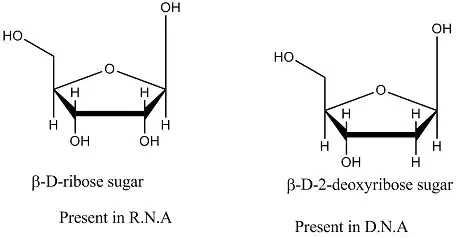
14. Which pentose sugar is present in RNA nucleotides?
A)
Ribose
B)
Glucose
C)
Fructose
D)
Glycerol
E)
Lactose
Theme:
Biology in the IMAT is centered on the fundamental mechanisms of life, from the molecular level (biochemistry and genetics) to the systemic level (anatomy and physiology). A deep understanding of how energy is transformed within a cell, such as through oxidative phosphorylation or glycolysis, is essential for understanding both health and disease states.
The study of human biology often requires integrating knowledge from multiple disciplines. For instance, the function of a protein is determined by its genetic code, its biochemical structure, and its physiological environment. Mastery of these concepts allows students to predict how a mutation or a drug might affect a specific metabolic pathway or organ system.
Theme: Molecular Biology - Nucleic Acid Composition
Nucleotides are the monomers that polymerize to form DNA and RNA. Each nucleotide consists of three parts: a nitrogenous base (A, T, C, G, or U), a phosphate group, and a 5-carbon pentose sugar. The identity of this sugar determines the fundamental nature of the nucleic acid.
- In DNA (Deoxyribonucleic Acid), the sugar is 2-deoxyribose. It lacks a hydroxyl group (-OH) at the 2' carbon position.
- In RNA (Ribonucleic Acid), the sugar is Ribose. It has a hydroxyl group at the 2' carbon.
This seemingly small difference (one oxygen atom) has profound structural consequences. The 2'-OH group in ribose makes RNA more chemically reactive and less stable than DNA, which is ideal for its role as a short-lived messenger (mRNA) or a catalytic molecule (ribozyme).
1. Analyze the term RNA: RNA stands for Ribonucleic Acid.
2. Identify the root: The prefix "Ribo-" refers to the sugar Ribose.
3. Confirm the classification: Ribose has 5 carbons ($C_5H_{10}O_5$), confirming it is a pentose.
4. Evaluate the options:
- A: Ribose (Correct).
- B: Glucose (Hexose, 6C).
- C: Fructose (Hexose, 6C).
- D: Glycerol (A 3-carbon alcohol, not a sugar).
- E: Lactose (A disaccharide).
Commonly, students mix up the sugars between DNA and RNA. Strategy: Use the names as a mnemonic. DNA has Deoxyribose. RNA has Ribose. Also, remember that Uracil is the base for RNA, while Thymine is for DNA.
Many antiviral drugs are Nucleoside Analogs. For example, drugs like Remdesivir (used for COVID-19) or AZT (for HIV) mimic the structure of ribose or deoxyribose. The viral polymerase incorporates these "fake" sugars into the growing viral genome, which then acts as a chain terminator, stopping viral replication. Understanding sugar chemistry is the key to designing effective anti-retroviral therapies.
→ A) Ribose
15
15. What are carrier proteins?
A)
They are the proteins that transfer molecules and ions across the plasma membrane
B)
They are proteins that phosphorylate enzymes in the plasma membrane.
C)
They are proteins that break down phospholipids in the plasma membrane.
D)
They are proteins that transport mRNA in the nucleus.
E)
They are proteins that transport tRNA in the nucleolus.
Theme:
Biology in the IMAT is centered on the fundamental mechanisms of life, from the molecular level (biochemistry and genetics) to the systemic level (anatomy and physiology). A deep understanding of how energy is transformed within a cell, such as through oxidative phosphorylation or glycolysis, is essential for understanding both health and disease states.
The study of human biology often requires integrating knowledge from multiple disciplines. For instance, the function of a protein is determined by its genetic code, its biochemical structure, and its physiological environment. Mastery of these concepts allows students to predict how a mutation or a drug might affect a specific metabolic pathway or organ system.
Theme: Cell Biology - Membrane Transport Mechanisms
The plasma membrane is a semi-permeable lipid bilayer that blocks the passage of polar or charged substances. To move these essential molecules (like glucose, amino acids, and ions) into or out of the cell, specialized transport proteins are required. There are two main types:
1. Channel Proteins: Act like tunnels that stay open or are gated, allowing specific ions to flow through rapidly via passive diffusion.
2. Carrier Proteins (Transporters): These bind to a specific solute, undergo a conformational change (change shape), and release the solute on the other side.
Carrier proteins can facilitate Passive Transport (facilitated diffusion, moving down a concentration gradient without energy) or Active Transport (using ATP to pump solutes against a gradient). They are highly specific, much like enzymes, having a binding site that only recognizes a particular molecule.
1. Define "Carrier" in a biological context: It implies a vehicle for moving something from point A to point B.
2. Analyze the location: Carrier proteins are typically integral membrane proteins located in the plasma membrane (or organelle membranes).
3. Evaluate functionality: Their job is transport.
4. Examine the choices:
- A: Describes the transfer of molecules/ions across the membrane (Correct).
- B: Describes a Kinase.
- C: Describes a Phospholipase.
- D & E: Describe nuclear transport proteins (like Exportins/Importins), but these are usually called "transporters" or "karyopherins," not the general "carrier proteins" referred to in membrane biology.
Don't confuse Carriers with Channels. Carriers *change shape* and have a lower transport rate; Channels are *pores* and are much faster. Strategy: If the question mentions "binding" or "shape change," think Carrier. If it mentions "diffusion" or "pore," think Channel.
Many diseases are caused by defective carrier proteins. Cystic Fibrosis is caused by a mutation in the CFTR protein (a type of ion transporter). Furthermore, many drugs target these proteins; for example, SSRI antidepressants (like Prozac) work by blocking the carrier protein responsible for the reuptake of serotonin into neurons, thereby increasing serotonin levels in the synaptic cleft.
→ A) They are the proteins that transfer molecules and ions across the plasma membrane
16
16. What is the cell's energy currency?
A)
ATP
B)
FADH2
C)
NADH
D)
Creatine
E)
NADPH
Theme:
Biology in the IMAT is centered on the fundamental mechanisms of life, from the molecular level (biochemistry and genetics) to the systemic level (anatomy and physiology). A deep understanding of how energy is transformed within a cell, such as through oxidative phosphorylation or glycolysis, is essential for understanding both health and disease states.
The study of human biology often requires integrating knowledge from multiple disciplines. For instance, the function of a protein is determined by its genetic code, its biochemical structure, and its physiological environment. Mastery of these concepts allows students to predict how a mutation or a drug might affect a specific metabolic pathway or organ system.
Theme: Metabolism - Bioenergetics and ATP
In the world of cellular biology, ATP (Adenosine Triphosphate) is the universal energy currency. It is a nucleotide consisting of an adenine base, a ribose sugar, and three phosphate groups. The energy is stored in the high-energy phosphoanhydride bonds between the phosphate groups. When the cell requires energy for work—such as muscle contraction, active transport, or chemical synthesis—it hydrolyzes the terminal phosphate bond, releasing a significant amount of free energy.
While other molecules like NADH and FADH\$_2\$ carry high-energy electrons, they act more like "checks" or "vouchers" that must be cashed in at the mitochondrial bank (the Electron Transport Chain) to produce ATP. ATP, however, is the "cash" that can be spent immediately by almost any enzyme or molecular motor in the cell. This standardization allows the cell to coordinate thousands of different reactions using a single, common energy intermediary.
1. Define "Energy Currency": A molecule that can be directly used to power a wide variety of endergonic (energy-consuming) cellular processes.
2. Evaluate the candidates:
- NADH / FADH$_2$: High-energy electron carriers used primarily in the Electron Transport Chain. They cannot directly power muscle contraction or most biosyntheses.
- NADPH: Used primarily as a reducing agent in anabolic reactions (like fatty acid synthesis), not as a general power source.
- Creatine (Phosphate): An energy *reserve* in muscle cells, used to quickly regenerate ATP, but not the primary currency itself.
- ATP: Directly coupled to thousands of enzymatic reactions.
3. Conclusion: ATP is the primary and universal energy currency.
Don't be fooled by NADH. While one molecule of NADH "worth" more energy (~2.5 ATP) than one ATP, it is not "liquid." The cell cannot spend NADH directly on most tasks. Strategy: Look for the molecule that is the *end product* of catabolic pathways and the *input* for anabolic ones. That is always ATP.
Many poisons work by interfering with the cell's ability to produce its energy currency. Cyanide, for example, blocks the final step of the Electron Transport Chain. This leads to a rapid "ATP crash," causing cell death within minutes, particularly in high-energy organs like the heart and brain. Understanding ATP production is also vital in treating Ischemia (lack of blood flow), where the primary damage to tissues is caused by the sudden depletion of ATP stores.
→ A) ATP
17
17. Which kind of reaction is ATP hydrolysis?
A)
exergonic
B)
endergonic
C)
condensation
D)
Oxidation-reduction
E)
Lipolysis
Theme:
Biology in the IMAT is centered on the fundamental mechanisms of life, from the molecular level (biochemistry and genetics) to the systemic level (anatomy and physiology). A deep understanding of how energy is transformed within a cell, such as through oxidative phosphorylation or glycolysis, is essential for understanding both health and disease states.
The study of human biology often requires integrating knowledge from multiple disciplines. For instance, the function of a protein is determined by its genetic code, its biochemical structure, and its physiological environment. Mastery of these concepts allows students to predict how a mutation or a drug might affect a specific metabolic pathway or organ system.
Theme: Thermodynamics in Biology - Free Energy Changes
Biological reactions are governed by the laws of thermodynamics. The change in Gibbs Free Energy (\$\Delta G\$) determines whether a reaction can occur spontaneously.
- Exergonic Reactions: Release free energy (\$\Delta G < 0\$). They are spontaneous.
- Endergonic Reactions: Absorb free energy (\$\Delta G > 0\$). They are non-spontaneous and require an input of energy.
The hydrolysis of ATP (\$\text{ATP} + \text{H}_2\text{O} → \text{ADP} + \text{P}_i\$) is a highly exergonic reaction, releasing approximately \$-30.5 \text{ kJ/mol}\$ under standard conditions (and even more under cellular conditions). The cell utilizes "energy coupling," where the energy released by this exergonic hydrolysis is used to "push" a necessary endergonic reaction forward. This is how life builds complex molecules and maintains order against the trend of entropy.
1. Analyze the chemical event: ATP hydrolysis involves breaking a phosphoanhydride bond.
2. Determine energy flow: Breaking this specific bond releases a large amount of chemical potential energy.
3. Apply thermodynamic definitions:
- Energy released = Negative $Delta G$.
- Negative $Delta G$ = Exergonic.
4. Evaluate other options:
- Condensation is the *opposite* of hydrolysis (joining molecules by removing water).
- Oxidation-reduction involves electron transfer (not the primary mechanism of simple hydrolysis).
- Lipolysis is a specific metabolic process (breakdown of fats), which involves hydrolysis but isn't a *type* of reaction itself.
Common confusion arises between "Exothermic" and "Exergonic." While related, Exothermic refers specifically to *heat* release ($Delta H$), whereas Exergonic refers to *work-available energy* release ($Delta G$). In biology, we almost always care about $Delta G$. Strategy: Associate "Hydrolysis" with "Releasing Energy" and "Exergonic."
In Hyperthermia or Malignant Hyperthermia, the body's coupling of ATP hydrolysis becomes inefficient or unregulated, leading to the excessive release of energy as heat instead of mechanical work. This can lead to dangerously high body temperatures and organ failure. Doctors must understand the thermodynamics of ATP to treat metabolic "storms" where the balance of energy production and consumption is lost.
→ A) exergonic
18
18. The presence of intercellular compartmentalisation is a characteristic of which organisms?
A)
Of eukaryotes
B)
Of viruses
C)
Of bacteria
D)
Of prokaryotes
E)
Only of algae
Theme:
Biology in the IMAT is centered on the fundamental mechanisms of life, from the molecular level (biochemistry and genetics) to the systemic level (anatomy and physiology). A deep understanding of how energy is transformed within a cell, such as through oxidative phosphorylation or glycolysis, is essential for understanding both health and disease states.
The study of human biology often requires integrating knowledge from multiple disciplines. For instance, the function of a protein is determined by its genetic code, its biochemical structure, and its physiological environment. Mastery of these concepts allows students to predict how a mutation or a drug might affect a specific metabolic pathway or organ system.
Theme: Cell Biology - Eukaryotic vs. Prokaryotic Organization
One of the most significant evolutionary leaps in biology was the development of intracellular compartmentalization. This refers to the partitioning of the cell's interior into membrane-bound organelles, such as the nucleus, mitochondria, lysosomes, and the endoplasmic reticulum. This organization allows the cell to create micro-environments with specific pH levels, enzyme concentrations, and substrates.
Eukaryotes (from the Greek for "true kernel," referring to the nucleus) are the organisms that possess this complex internal structure. Prokaryotes (bacteria and archaea), by contrast, generally lack these membrane-bound compartments, with their biochemical processes occurring primarily in the cytoplasm or across the plasma membrane. Compartmentalization allows eukaryotic cells to grow much larger than prokaryotic ones, as it overcomes the limitations of simple diffusion.
1. Define "Compartmentalization": The presence of membrane-bound internal "rooms" (organelles).
2. Compare domains of life:
- Viruses: Non-cellular; they have a protein coat (capsid) and genetic material but no metabolism or internal compartments.
- Bacteria / Prokaryotes: Single-celled organisms with no nucleus or membrane-bound organelles.
- Eukaryotes: Include animals, plants, fungi, and protists. All have a nucleus and organelles.
3. Evaluate options:
- A: Eukaryotes (Matches the definition).
- E: "Only of algae" is too restrictive; it applies to all eukaryotes.
4. Conclusion: Compartmentalization is the hallmark of eukaryotes.
Watch out for "half-truths" like option E. While algae *do* have compartments, the word "only" makes it factually incorrect in the broader context of biology. Strategy: In taxonomy questions, the most inclusive and scientifically accurate group (in this case, the entire Domain Eukarya) is usually the correct answer.
Understanding compartmentalization is essential for Pharmacology and Toxicology. For example, the drug Chloroquine works by concentrating inside the acidic compartment (lysosome/vacuole) of the malaria parasite. If the parasite loses its compartmentalization or pH gradient, the drug fails. Similarly, many human "storage diseases" (like Tay-Sachs) are caused by the failure of a single enzyme within a specific compartment (the lysosome).
→ A) Of eukaryotes
19
19. Which intracellular structure is composed of microtubules?
A)
The centriole
B)
The nucleus
C)
The Golgi apparatus
D)
The nucleolus
E)
The endoplasmic reticulum
Theme:
Biology in the IMAT is centered on the fundamental mechanisms of life, from the molecular level (biochemistry and genetics) to the systemic level (anatomy and physiology). A deep understanding of how energy is transformed within a cell, such as through oxidative phosphorylation or glycolysis, is essential for understanding both health and disease states.
The study of human biology often requires integrating knowledge from multiple disciplines. For instance, the function of a protein is determined by its genetic code, its biochemical structure, and its physiological environment. Mastery of these concepts allows students to predict how a mutation or a drug might affect a specific metabolic pathway or organ system.
Theme: Cell Biology - The Cytoskeleton
The cytoskeleton is a dynamic network of protein filaments that provides structural support and facilitates movement. It consists of three main fibers:
1. Microfilaments (Actin): Smallest (7nm), involved in muscle contraction and cell shape.
2. Intermediate Filaments (e.g., Keratin): Mid-sized (10nm), provide mechanical strength.
3. Microtubules (Tubulin): Largest (25nm), hollow tubes involved in intracellular transport and cell division.
Centrioles are specialized structures found in animal cells, occurring in pairs at the center of the centrosome. Each centriole is composed of nine triplets of microtubules arranged in a ring (a "9+0" pattern). They are critical for organizing the mitotic spindle during cell division and forming the basal bodies that anchor cilia and flagella.
1. Identify the protein component: The question asks for structures made of Microtubules (Tubulin).
2. Analyze the options:
- Nucleus / Golgi / ER: These are membrane-bound organelles made primarily of lipid bilayers and associated proteins, not structural microtubule scaffolds.
- Nucleolus: A dense region of RNA and protein inside the nucleus.
- Centriole: Known to be a "Microtubule Organizing Center" (MTOC) component, constructed specifically from microtubule triplets.
3. Conclusion: Option A is the structural match.
Students often confuse the Centriole (the structure) with the Centrosome (the region) or the Centromere (the DNA part of a chromosome). Strategy: Remember that Centrioles are Cylinders made of tubes. Use the "9+0" or "9+2" (for cilia) microtubule arrangement as a mental trigger for microtubule-based structures.
Microtubules are the primary target for several Chemotherapy Drugs. Drugs like Paclitaxel (Taxol) or Vincristine work by interfering with microtubule assembly or disassembly. Since centrioles and the mitotic spindle (made of microtubules) are required for cell division, these drugs effectively stop cancer cells from replicating. Understanding the composition of centrioles is therefore fundamental to oncology.
→ A) The centriole
20
20. Mitochondria have:
A)
An outer membrane and a very selective inner membrane
B)
Only a very selective outer membrane
C)
An outer membrane, an intermediate membrane, and a very selective inner membrane
D)
An outer membrane consisting of a phospholipid monolayer
E)
A very selective membrane in which no proteins are present
Theme:
Biology in the IMAT is centered on the fundamental mechanisms of life, from the molecular level (biochemistry and genetics) to the systemic level (anatomy and physiology). A deep understanding of how energy is transformed within a cell, such as through oxidative phosphorylation or glycolysis, is essential for understanding both health and disease states.
The study of human biology often requires integrating knowledge from multiple disciplines. For instance, the function of a protein is determined by its genetic code, its biochemical structure, and its physiological environment. Mastery of these concepts allows students to predict how a mutation or a drug might affect a specific metabolic pathway or organ system.
Theme: Cell Biology - Mitochondrial Ultrastructure
The structure of the mitochondrion supports the Endosymbiotic Theory, which suggests mitochondria were once free-living prokaryotes. They possess a double-membrane system:
- Outer Membrane: Relatively simple and contains large pore-forming proteins called porins, making it permeable to small molecules and ions.
- Inner Membrane: Highly specialized and extremely selective. It lacks porins and is impermeable to most ions (including protons, \$\text{H}^+\$). This selectivity is vital for maintaining the electrochemical gradient used by ATP synthase to produce energy. It is also the site of the Electron Transport Chain proteins.
The space between these two is the intermembrane space, and the interior is the matrix. This "dual-layer" design is the fundamental requirement for the chemiosmotic production of ATP.
1. Recall basic anatomy: Mitochondria are double-membraned. (Eliminates B).
2. Check for "Intermediate" membranes: There is no third membrane. (Eliminates C).
3. Analyze membrane composition: All biological membranes are bilayers, not monolayers. (Eliminates D).
4. Assess selectivity:
- Outer membrane = Permeable (via porins).
- Inner membrane = Highly selective (to maintain gradients).
5. Evaluate protein presence: Biological membranes, especially the inner mitochondrial one, are packed with proteins (up to 75% by mass). (Eliminates E).
6. Conclusion: Option A correctly describes the two membranes and their relative selectivity.
A common error is thinking that "selective" means "nothing gets through." In biology, "very selective" means that passage is strictly regulated by specific transporters. Strategy: If you see "monolayer" or "no proteins" in a question about biological membranes, it is almost certainly a distractor.
The selectivity of the inner membrane is why certain toxins are so deadly. For example, Uncoupling Agents (like 2,4-DNP) make the inner membrane "leaky" to protons. This destroys the proton gradient, meaning the cell burns fuel at a massive rate but produces no ATP, generating only heat. This leads to fatal hyperthermia. Doctors monitor mitochondrial membrane potential as a marker of cell health and "stress."
→ A) An outer membrane and a very selective inner membrane
21
21. What is an anticodon?
A)
The sequence of three nucleotides found on the tRNA corresponding to a codon on the mRNA.
B)
A sequence three nucleotides transcribed from the mRNA and translated by rRNA
C)
A part of the DNA that codes for a specific amino acid
D)
A terminal triplet of rRNA that binds a specific amino acid
E)
The sequence of three mRNA nucleotides corresponding to a DNA codon
Theme:
Biology in the IMAT is centered on the fundamental mechanisms of life, from the molecular level (biochemistry and genetics) to the systemic level (anatomy and physiology). A deep understanding of how energy is transformed within a cell, such as through oxidative phosphorylation or glycolysis, is essential for understanding both health and disease states.
The study of human biology often requires integrating knowledge from multiple disciplines. For instance, the function of a protein is determined by its genetic code, its biochemical structure, and its physiological environment. Mastery of these concepts allows students to predict how a mutation or a drug might affect a specific metabolic pathway or organ system.
Theme: Molecular Biology - The Mechanism of Translation
The "Central Dogma" describes the flow of genetic information: DNA → RNA → Protein. During the final step, Translation, the sequence of nucleotides in an mRNA molecule is "decoded" into a sequence of amino acids. This decoding is performed by tRNA (transfer RNA) molecules.
Each tRNA molecule has two critical regions:
1. Amino Acid Attachment Site: Where a specific amino acid is enzymatically linked.
2. Anticodon: A triplet of nucleotides at the bottom of the tRNA cloverleaf.
The anticodon is complementary and antiparallel to a specific codon on the mRNA. For example, if the mRNA codon is 5'-AUG-3', the corresponding tRNA anticodon would be 3'-UAC-5'. This base-pairing ensures that the correct amino acid is added to the growing polypeptide chain according to the instructions in the mRNA.
1. Define the components:
- Codon = mRNA (3 bases).
- Anticodon = tRNA (3 bases).
2. Establish the relationship: They base-pair with each other during translation at the ribosome.
3. Evaluate the options:
- A: Correctly identifies the anticodon on tRNA and its relationship to the mRNA codon.
- B: mRNA is not "transcribed from mRNA."
- C: DNA triplets are usually just called "triplets" or "genetic code units," not anticodons.
- D: rRNA forms the ribosome structure; it doesn't carry anticodons for specific amino acids.
- E: An mRNA triplet is a codon, not an anticodon.
The most common mistake is swapping the locations of the codon and anticodon. Strategy: Remember the "m" in mRNA stands for Message (the code/codon), and the "t" in tRNA stands for Transport (carrying the anti-code).
Many antibiotics work by targeting this specific interaction. For example, Tetracyclines bind to the bacterial ribosome and block the tRNA anticodon from pairing with the mRNA codon. This halts protein synthesis in the bacteria, eventually killing it. Understanding anticodons is also crucial in studying Mitochondrial Diseases, where mutations in mitochondrial tRNA genes lead to "misreading" of the genetic code and severe metabolic failure.
→ A) The sequence of three nucleotides found on the tRNA corresponding to a codon on the mRNA.
22
22. What are ribosomes made of?
A)
RNA and proteins
B)
DNA and proteins
C)
DNA and lipids
D)
RNA and DNA
E)
RNA, DNA, and proteins
Theme:
Biology in the IMAT is centered on the fundamental mechanisms of life, from the molecular level (biochemistry and genetics) to the systemic level (anatomy and physiology). A deep understanding of how energy is transformed within a cell, such as through oxidative phosphorylation or glycolysis, is essential for understanding both health and disease states.
The study of human biology often requires integrating knowledge from multiple disciplines. For instance, the function of a protein is determined by its genetic code, its biochemical structure, and its physiological environment. Mastery of these concepts allows students to predict how a mutation or a drug might affect a specific metabolic pathway or organ system.
Theme: Cell Biology - Ribosome Structure and Composition
Ribosomes are the "protein factories" of the cell, responsible for translating the genetic code into functional polypeptide chains. Unlike many other organelles, ribosomes are not membrane-bound. Instead, they are complex ribonucleoprotein particles. This means they are composed of two distinct types of macromolecules: Ribosomal RNA (rRNA) and Ribosomal Proteins.
In eukaryotes, the ribosome consists of a large (60S) and a small (40S) subunit, which together form the 80S ribosome. The rRNA provides the structural scaffold and, crucially, acts as the catalyst for peptide bond formation (meaning the ribosome is a ribozyme). The proteins are generally found on the exterior, stabilizing the rRNA core and facilitating the dynamic conformational changes required during the translation cycle.
1. Define the function: Ribosomes perform protein synthesis (translation).
2. Recall the chemical nature: They are ribonucleoproteins.
- "Ribonucleo-" refers to RNA (specifically rRNA).
- "-protein" refers to Proteins.
3. Check for DNA presence: Ribosomes translate mRNA into protein. While DNA provides the *template* for mRNA in the nucleus, DNA itself is never a structural component of the ribosome.
4. Evaluate options:
- A: RNA and proteins (Matches known composition).
- B, D, E: Incorrectly include DNA.
- C: Incorrectly includes DNA and lipids.
5. Conclusion: Ribosomes are made of RNA and proteins.
Students often confuse the *content* of the nucleus (DNA + proteins) with the *content* of ribosomes. Strategy: Remember that DNA "stays in the library" (the nucleus), while RNA "goes to the factory" (the ribosome). If an organelle is outside the nucleus and not involved in energy or transport, it almost certainly doesn't contain DNA.
Ribosomes are the primary target for many Antibiotics. Because bacterial ribosomes (70S) are structurally different from human ribosomes (80S), drugs like Macrolides (e.g., Erythromycin) or Aminoglycosides can selectively bind to bacterial rRNA and stop their protein production without harming the human host. Understanding ribosome composition is the basis of selective toxicity in clinical microbiology.
→ A) RNA and proteins
23
23. The cell membrane consists of:
A)
a double phospholipid layer with hydrophobic tails facing inward and the presence of integral and peripheral proteins
B)
Cholesterol and phospholipid molecules enclosing a protein layer
C)
A double layer of triglycerides and cholesterol
D)
A glycoprotein layer containing phospholipids and cholesterol
E)
A layer of fatty acids and globular proteins containing phospholipids and cholesterol
Theme:
Biology in the IMAT is centered on the fundamental mechanisms of life, from the molecular level (biochemistry and genetics) to the systemic level (anatomy and physiology). A deep understanding of how energy is transformed within a cell, such as through oxidative phosphorylation or glycolysis, is essential for understanding both health and disease states.
The study of human biology often requires integrating knowledge from multiple disciplines. For instance, the function of a protein is determined by its genetic code, its biochemical structure, and its physiological environment. Mastery of these concepts allows students to predict how a mutation or a drug might affect a specific metabolic pathway or organ system.
Theme: Cell Biology - The Fluid Mosaic Model
The plasma membrane is the dynamic boundary that defines the cell and regulates its interactions with the environment. According to the Fluid Mosaic Model, the membrane is a "mosaic" of various molecules (proteins, steroids, carbohydrates) floating in or on a "fluid" phospholipid bilayer.
Phospholipids are amphipathic molecules, meaning they have both a hydrophilic (water-loving) phosphate head and two hydrophobic (water-fearing) fatty acid tails. In an aqueous environment, they spontaneously organize into a bilayer where the heads face the water (extracellular fluid and cytoplasm) and the tails hide in the center, away from water. Integral proteins span the bilayer, while peripheral proteins are attached to the surface. Cholesterol molecules are interspersed among the phospholipids to regulate membrane fluidity across different temperatures.
1. Identify the primary structural unit: The phospholipid bilayer.
2. Analyze the orientation:
- Heads (Hydrophilic) = Outward.
- Tails (Hydrophobic) = Inward.
3. Identify secondary components:
- Proteins: Integral (through) and Peripheral (on the side).
- Steroids: Cholesterol (for fluidity).
4. Evaluate options:
- A: Correctly identifies the bilayer, the orientation of the tails, and the presence of proteins.
- B: Incorrectly suggests proteins are "enclosed" like a sandwich filling (the old Davson-Danielli model).
- C: Triglycerides are storage fats (droplets), not membrane fats.
- E: Fatty acids alone cannot form a bilayer; they need the glycerol/phosphate head group.
A common trap is the "Sandwich Model" (Option B). While it sounds logical, it was disproven in the 1970s. Proteins are *embedded* in the fluid, not a static layer outside it. Strategy: Associate the word "Tails" with "Inward" and "Hydrophobic." This orientation is the most frequently tested aspect of membrane anatomy.
Membrane integrity is critical for physiological function. In Anesthetics, many gases work by dissolving into the lipid bilayer of neurons, altering the membrane's fluidity and affecting the function of ion channels, which leads to a loss of consciousness. Furthermore, many genetic diseases, such as Familial Hypercholesterolemia, involve defective membrane proteins (receptors) that fail to clear LDL from the blood, leading to early-onset heart disease.
→ A) a double phospholipid layer with hydrophobic tails facing inward and the presence of integral and peripheral proteins
24
24. In protein synthesis, what is translation?
A)
It is the process by which mRNA is read and converted into a specific sequence of amino acids.
B)
It is the process of transcribing the mRNA sequence into a corresponding DNA molecule.
C)
It is the process of specific recognition of rRNA by amino acids.
D)
It is the process in which DNA is read and the corresponding mRNA produced.
E)
It is the process of pairing between DNA codons and tRNA anticodons.
Theme:
Biology in the IMAT is centered on the fundamental mechanisms of life, from the molecular level (biochemistry and genetics) to the systemic level (anatomy and physiology). A deep understanding of how energy is transformed within a cell, such as through oxidative phosphorylation or glycolysis, is essential for understanding both health and disease states.
The study of human biology often requires integrating knowledge from multiple disciplines. For instance, the function of a protein is determined by its genetic code, its biochemical structure, and its physiological environment. Mastery of these concepts allows students to predict how a mutation or a drug might affect a specific metabolic pathway or organ system.
Theme: Molecular Biology - Gene Expression
Translation is the second major stage of gene expression. After DNA is transcribed into mRNA in the nucleus (in eukaryotes), the mRNA travels to the ribosome in the cytoplasm. Here, the "language" of nucleic acids (nucleotide sequences) is "translated" into the "language" of proteins (amino acid sequences).
The process involves the ribosome reading the mRNA in groups of three bases called codons. Each codon corresponds to a specific amino acid, brought to the ribosome by a tRNA molecule. The genetic code is redundant (multiple codons for one amino acid) but unambiguous (one codon never codes for more than one amino acid). This high-fidelity process is essential for creating the precise three-dimensional shapes required for protein function.
1. Define the inputs and outputs:
- Input: mRNA (Nucleotides).
- Output: Polypeptide/Protein (Amino acids).
2. Evaluate the options based on this flow:
- A: mRNA → Amino acids (Correct).
- B: mRNA → DNA (This is Reverse Transcription).
- D: DNA → mRNA (This is Transcription).
- E: Mentions DNA codons; codons for translation are found on mRNA.
3. Conclusion: Translation is the conversion of mRNA information into a sequence of amino acids.
Students frequently mix up Transcription and Translation. Strategy: Think of a scribe. A scribe copies text in the same language (Transcription: DNA and RNA are both "nucleic acid language"). A translator changes the text into a *different* language (Translation: Nucleics to Proteins).
Translation is a highly regulated process. In Cancer, cells often hijack the translation machinery to overproduce growth-promoting proteins. Many modern "targeted therapies" work by inhibiting specific translation initiation factors. Additionally, some Toxins (like Ricin or Diphtheria toxin) work by enzymatically inactivating the ribosome, completely halting translation and causing rapid cell death.
→ A) It is the process by which mRNA is read and converted into a specific sequence of amino acids.
25
25. What are the principal components of the cytoskeleton?
A)
Microtubules, microfilaments, and intermediate filaments
B)
Microtubules, myosin, and filamin
C)
Microtubules, dynein, and myosin
D)
Actin, myosin and dynein
E)
Collagen fibres and reticular fibres
Theme:
Biology in the IMAT is centered on the fundamental mechanisms of life, from the molecular level (biochemistry and genetics) to the systemic level (anatomy and physiology). A deep understanding of how energy is transformed within a cell, such as through oxidative phosphorylation or glycolysis, is essential for understanding both health and disease states.
The study of human biology often requires integrating knowledge from multiple disciplines. For instance, the function of a protein is determined by its genetic code, its biochemical structure, and its physiological environment. Mastery of these concepts allows students to predict how a mutation or a drug might affect a specific metabolic pathway or organ system.
Theme: Cell Biology - Cytoskeletal Architecture
The cytoskeleton is not a rigid "skeleton" but a dynamic and flexible framework that gives the cell its shape, allows for movement, and organizes the internal organelles. It is composed of three distinct types of protein fibers, categorized by their diameter and the proteins they are made of:
1. Microfilaments (Actin Filaments): 7nm diameter. Primarily made of actin. Responsible for cell crawling, cytokinesis, and muscle contraction.
2. Intermediate Filaments: 8-12nm diameter. Made of various proteins (e.g., keratin, vimentin). Provide mechanical strength and anchor the nucleus.
3. Microtubules: 25nm diameter. Made of $alpha$- and $eta$-tubulin. Act as tracks for organelle movement and form the mitotic spindle.
1. Recall the triad: The cytoskeleton is defined by the three specific fiber types: Microtubules, Microfilaments, and Intermediate Filaments.
2. Examine the choices:
- A: Lists all three correctly (Correct).
- B, C, D: Include Myosin or Dynein. These are Motor Proteins that *walk* on the cytoskeleton, but they are not the structural filaments themselves.
- E: Lists extracellular matrix fibers (found *outside* the cell), not the cytoskeleton (found *inside* the cell).
3. Conclusion: Option A represents the structural pillars of the cell.
The inclusion of "Myosin" or "Actin" (in Option D) is a common distractor. While actin makes up microfilaments, the question asks for the *components* of the cytoskeleton as a system. Myosin and Dynein are *associated* with it but are separate enzymatic entities. Strategy: Memorize the "Three Sizes" (Micro, Intermediate, and Microtubules) as the standard answer for cytoskeletal composition.
Cytoskeletal defects lead to a wide array of pathologies. Epidermolysis Bullosa is a skin-blistering disease caused by mutations in intermediate filaments (keratin). Kartagener Syndrome is caused by defective microtubules in cilia, leading to chronic respiratory infections and infertility. Understanding these fibers is crucial for diagnosing structural cellular diseases.
→ A) Microtubules, microfilaments, and intermediate filaments
26
26. The term "allele" defines:
A)
one of several alternative forms of a gene
B)
A coding DNA base for a specific amino acid
C)
A hereditary trait only found in haploid cells
D)
The phenotypic manifestation of a given gene
E)
A set of coding DNA triplets for a specific amino acid
Theme:
Biology in the IMAT is centered on the fundamental mechanisms of life, from the molecular level (biochemistry and genetics) to the systemic level (anatomy and physiology). A deep understanding of how energy is transformed within a cell, such as through oxidative phosphorylation or glycolysis, is essential for understanding both health and disease states.
The study of human biology often requires integrating knowledge from multiple disciplines. For instance, the function of a protein is determined by its genetic code, its biochemical structure, and its physiological environment. Mastery of these concepts allows students to predict how a mutation or a drug might affect a specific metabolic pathway or organ system.
Theme: Genetics - Fundamental Terminology
A gene is a segment of DNA that contains the instructions for a specific trait (e.g., eye color). However, genes can exist in slightly different versions. These alternative versions are called alleles. For example, the gene for blood type has three main alleles: A, B, and O.
In diploid organisms (like humans), an individual carries two alleles for every gene—one inherited from each parent. These alleles reside at the same locus (position) on homologous chromosomes. If the two alleles are the same, the individual is homozygous; if they are different, the individual is heterozygous. The combination of these alleles is the genotype, which then determines the observable phenotype.
1. Analyze the concept: Allele = Variation of a gene.
2. Evaluate the options:
- A: Correctly identifies them as alternative forms of a gene.
- B & E: Describe parts of a gene (bases/codons), but not the variants of the gene itself.
- C: Alleles are found in all living things with genes, both haploid and diploid.
- D: The phenotypic manifestation is the Phenotype, not the allele.
3. Conclusion: Alleles are the diverse forms a single gene can take.
Don't confuse Allele with Locus. The Locus is the "address" (the physical location), while the Allele is the "resident" ( the specific version of the gene living there). Strategy: Think of a gene as a "Slot" and alleles as the "Different Coins" you can put into that slot.
Understanding alleles is the foundation of Personalized Medicine. Many diseases are caused by specific "disease-causing alleles" (mutations). For instance, Sickle Cell Anemia occurs when an individual inherits two copies of a specific mutant allele for the hemoglobin gene. Genetic testing allows doctors to identify these alleles early and tailor treatments to a patient's specific genetic makeup.
→ A) one of several alternative forms of a gene
27
27. In a heterozygous condition, an allele can certainly express itself when:
A)
dominant
B)
recessive
C)
mutated
D)
multiple
E)
associated
Theme:
Biology in the IMAT is centered on the fundamental mechanisms of life, from the molecular level (biochemistry and genetics) to the systemic level (anatomy and physiology). A deep understanding of how energy is transformed within a cell, such as through oxidative phosphorylation or glycolysis, is essential for understanding both health and disease states.
The study of human biology often requires integrating knowledge from multiple disciplines. For instance, the function of a protein is determined by its genetic code, its biochemical structure, and its physiological environment. Mastery of these concepts allows students to predict how a mutation or a drug might affect a specific metabolic pathway or organ system.
Theme: Genetics - Mendelian Inheritance Patterns
Mendelian genetics describes how traits are passed from parents to offspring. In a heterozygous individual (having two different alleles for a gene, e.g., \$Aa\$), the relationship between the two alleles determines the outcome.
- Dominant Allele (\$A\$): An allele that fully expresses its phenotype even when only one copy is present. It "masks" the presence of the other allele.
- Recessive Allele ($a$): An allele that only expresses its phenotype when the individual is homozygous (e.g., $aa$). In the heterozygous state ($Aa$), its effect is hidden.
This hierarchy is the simplest form of inheritance. More complex patterns include Co-dominance (both expressed, like blood type AB) and Incomplete Dominance (a blend of both, like pink flowers from red and white parents).
1. Define Heterozygous: Genotype = $Aa$ (one of each).
2. Analyze allele types:
- If $A$ is Dominant, the phenotype will be the "A" trait.
- If $a$ is Recessive, the phenotype will *not* be the "a" trait.
3. Evaluate the condition for "certain expression": For an allele to *always* show up in the presence of a different allele, it must be dominant.
4. Evaluate other options: "Mutated" alleles can be dominant or recessive. "Multiple" refers to how many alleles exist in a population, not their expression in an individual.
A common error is assuming that "dominant" means "common" or "stronger" in terms of survival. This is false; some dominant alleles are lethal and rare (e.g., Huntington's disease). Strategy: Dominance refers *strictly* to the ability to show the trait in a heterozygous ($Aa$) individual.
Many genetic disorders follow a Autosomal Dominant pattern. If a parent has a dominant disease-causing allele (like for Huntington's Disease or Marfan Syndrome), there is a 50% chance they will pass it to their child, and the child will *certainly* express the disease if they inherit that single allele. Understanding dominance is vital for genetic counseling and risk assessment for families.
→ A) dominant
28
28. What are mutations?
A)
Alterations in the genetic information of a cell
B)
Alteration in the energy metabolism of a cell
C)
Alterations in enzyme functionality during zygote formation
D)
Alterations in the active transport system of biological membranes
E)
Alterations in the mechanism of cell division.
Theme:
Biology in the IMAT is centered on the fundamental mechanisms of life, from the molecular level (biochemistry and genetics) to the systemic level (anatomy and physiology). A deep understanding of how energy is transformed within a cell, such as through oxidative phosphorylation or glycolysis, is essential for understanding both health and disease states.
The study of human biology often requires integrating knowledge from multiple disciplines. For instance, the function of a protein is determined by its genetic code, its biochemical structure, and its physiological environment. Mastery of these concepts allows students to predict how a mutation or a drug might affect a specific metabolic pathway or organ system.
Theme: Genetics - Mutations
A mutation is a change or alteration in the genetic information (the DNA sequence) of a cell. This can range from a single base-pair change (point mutation) to large-scale changes like deletions, insertions, or rearrangements of chromosomes. Mutations are the ultimate source of genetic variation.
- B, C, D, E): These are all potential *consequences* or *results* of a mutation, but they are not the definition of the mutation itself. A mutation in a gene might *cause* an alteration in energy metabolism, enzyme function, active transport, or cell division, but the mutation *is* the change in the DNA.
→ A) Alterations in the genetic information of a cell
29
29. Translation is a process which:
A)
leads to the synthesis of polypeptide chains from mRNA
B)
occurs in the nucleus of eukaryotic cells
C)
leads to the synthesis of RNA from DNA
D)
is very similar to transcription
E)
Is exclusively eukaryotic
Theme:
Biology in the IMAT is centered on the fundamental mechanisms of life, from the molecular level (biochemistry and genetics) to the systemic level (anatomy and physiology). A deep understanding of how energy is transformed within a cell, such as through oxidative phosphorylation or glycolysis, is essential for understanding both health and disease states.
The study of human biology often requires integrating knowledge from multiple disciplines. For instance, the function of a protein is determined by its genetic code, its biochemical structure, and its physiological environment. Mastery of these concepts allows students to predict how a mutation or a drug might affect a specific metabolic pathway or organ system.
Theme: Molecular Biology - Translation
Translation is the process where ribosomes synthesize polypeptide chains (proteins) using the information encoded in an mRNA molecule.
- B): In eukaryotes, translation occurs in the cytoplasm (on free ribosomes) or on the rough endoplasmic reticulum. Transcription occurs in the nucleus.
- C): The synthesis of RNA from DNA is transcription.
- D): Translation (RNA to protein) and transcription (DNA to RNA) are fundamentally different processes.
- E): Translation is a universal process, occurring in both prokaryotes and eukaryotes.
→ A) leads to the synthesis of polypeptide chains from mRNA
30
30. If the sequence CCGTTATTGA is found on a strand of DNA helix, what sequence will be found on the complementary strand?
A)
GGCAATAACT
B)
AGTTATTGCC
C)
GGACATCCCT
D)
CGCACCTCCT
E)
GGCAATTAAT
Theme:
Biology in the IMAT is centered on the fundamental mechanisms of life, from the molecular level (biochemistry and genetics) to the systemic level (anatomy and physiology). A deep understanding of how energy is transformed within a cell, such as through oxidative phosphorylation or glycolysis, is essential for understanding both health and disease states.
The study of human biology often requires integrating knowledge from multiple disciplines. For instance, the function of a protein is determined by its genetic code, its biochemical structure, and its physiological environment. Mastery of these concepts allows students to predict how a mutation or a drug might affect a specific metabolic pathway or organ system.
Theme: Molecular Biology - DNA Structure
DNA is a double helix with complementary base pairing rules:
- Adenine (A) pairs with Thymine (T).
- Guanine (G) pairs with Cytosine (C).
We need to find the complementary sequence to the template strand CCGTTATTGA:
- C → G
- C → G
- G → C
- T → A
- T → A
- A → T
- T → A
- T → A
- G → C
- A → T
The complementary strand is GGCAATAACT.
→ A) GGCAATAACT
28
28. What are mutations?
A)
Alterations in the genetic information of a cell
B)
Alteration in the energy metabolism of a cell
C)
Alterations in enzyme functionality during zygote formation
D)
Alterations in the active transport system of biological membranes
E)
Alterations in the mechanism of cell division.
Theme:
Biology in the IMAT is centered on the fundamental mechanisms of life, from the molecular level (biochemistry and genetics) to the systemic level (anatomy and physiology). A deep understanding of how energy is transformed within a cell, such as through oxidative phosphorylation or glycolysis, is essential for understanding both health and disease states.
The study of human biology often requires integrating knowledge from multiple disciplines. For instance, the function of a protein is determined by its genetic code, its biochemical structure, and its physiological environment. Mastery of these concepts allows students to predict how a mutation or a drug might affect a specific metabolic pathway or organ system.
Theme: Genetics - Molecular Basis of Mutation
A mutation is defined as a permanent, heritable change in the nucleotide sequence of the genome of an organism. Mutations can occur at the level of a single nucleotide (point mutations), such as substitutions, insertions, or deletions, or at the chromosomal level, involving large-scale rearrangements like inversions or translocations. While the word "mutation" often carries a negative connotation, mutations are the primary source of genetic variation and the raw material upon which evolution acts.
Mutations can be caused by external factors called mutagens (e.g., UV radiation, chemicals like tobacco smoke) or by internal errors during DNA replication. If a mutation occurs in a germline cell (sperm or egg), it can be passed to offspring. If it occurs in a somatic cell, it may lead to localized effects, such as the formation of a tumor, but will not be inherited by the next generation.
1. Define the core concept: Mutation = change in DNA.
2. Evaluate the options based on the definition:
- A: "Alterations in genetic information" (DNA is the information). This is the direct definition.
- B, C, D, E: Describe metabolic, enzymatic, or structural *consequences* that *might* result from a mutation, but they are not the mutation itself.
3. Synthesize: A mutation is the *cause* (the change in the code), while the other options describe potential *effects* (phenotypic changes).
4. Conclusion: Option A is the only choice that defines the fundamental nature of a mutation.
A common pitfall is choosing an option that describes a disease state (like altered cell division in cancer). Strategy: Always distinguish between the Genotype (the change in DNA/information) and the Phenotype ( the functional change in the cell). A mutation is a genotypic change.
In medicine, mutations are the root cause of Genetic Disorders (like Cystic Fibrosis) and Cancer. Oncogenes and tumor suppressor genes are specific parts of the "genetic information" that, when mutated, lead to unregulated cell growth. Understanding the nature of mutations allows clinicians to use Gene Therapy to attempt to "correct" the altered information at the molecular level.
→ A) Alterations in the genetic information of a cell
29
29. Translation is a process which:
A)
leads to the synthesis of polypeptide chains from mRNA
B)
occurs in the nucleus of eukaryotic cells
C)
leads to the synthesis of RNA from DNA
D)
is very similar to transcription
E)
Is exclusively eukaryotic
Theme:
Biology in the IMAT is centered on the fundamental mechanisms of life, from the molecular level (biochemistry and genetics) to the systemic level (anatomy and physiology). A deep understanding of how energy is transformed within a cell, such as through oxidative phosphorylation or glycolysis, is essential for understanding both health and disease states.
The study of human biology often requires integrating knowledge from multiple disciplines. For instance, the function of a protein is determined by its genetic code, its biochemical structure, and its physiological environment. Mastery of these concepts allows students to predict how a mutation or a drug might affect a specific metabolic pathway or organ system.
Theme: Molecular Biology - Protein Synthesis
Translation is the final stage of the flow of genetic information. It is the process where a ribosome reads the sequence of an mRNA molecule and, using tRNA adapters, assembles a specific sequence of amino acids into a polypeptide chain. This process occurs in the cytoplasm (either on free ribosomes or on the Rough ER) of all living cells, whether they are prokaryotic or eukaryotic.
The process is divided into three main phases:
1. Initiation: The small ribosomal subunit binds to the start codon (AUG).
2. Elongation: The ribosome moves along the mRNA, adding amino acids one by one via peptide bonds.
3. Termination: The ribosome reaches a stop codon, and the completed polypeptide is released.
1. Define the process: Translation = mRNA \$→\$ Protein (Polypeptide).
2. Examine the options:
- A: Synthesis of polypeptides from mRNA (Correct).
- B: Occurs in the nucleus (Incorrect; Transcription happens in the nucleus; Translation happens in the cytoplasm).
- C: RNA from DNA (This is Transcription).
- D: "Very similar" (Incorrect; Transcription and Translation use different enzymes, different locations, and different "languages").
- E: "Exclusively eukaryotic" (Incorrect; Bacteria also perform translation—it is a universal process of life).
3. Conclusion: Option A is the standard definition of translation.
Students often confuse the *location* of these processes in eukaryotes. Strategy: Remember that DNA never leaves the nucleus in a healthy cell. Therefore, anything involving DNA (Replication, Transcription) must be in the nucleus. Anything involving the "final product" (Protein) happens in the cytoplasm.
Many Metabolic Poisons and Antibiotics target translation. For instance, the toxin Ricin removes a single adenine base from rRNA, which "breaks" the ribosome and stops all translation, leading to systemic organ failure. Understanding the mechanics of translation is also essential for developing mRNA Vaccines, which work by introducing a synthetic mRNA into human cells to "translate" a viral protein and trigger an immune response.
→ A) leads to the synthesis of polypeptide chains from mRNA
30
30. If the sequence CCGTTATTGA is found on a strand of DNA helix, what sequence will be found on the complementary strand?
A)
GGCAATAACT
B)
AGTTATTGCC
C)
GGACATCCCT
D)
CGCACCTCCT
E)
GGCAATTAAT
Theme:
Biology in the IMAT is centered on the fundamental mechanisms of life, from the molecular level (biochemistry and genetics) to the systemic level (anatomy and physiology). A deep understanding of how energy is transformed within a cell, such as through oxidative phosphorylation or glycolysis, is essential for understanding both health and disease states.
The study of human biology often requires integrating knowledge from multiple disciplines. For instance, the function of a protein is determined by its genetic code, its biochemical structure, and its physiological environment. Mastery of these concepts allows students to predict how a mutation or a drug might affect a specific metabolic pathway or organ system.
Theme: Molecular Biology - DNA Base Pairing Rules
The DNA double helix is held together by hydrogen bonds between complementary nitrogenous bases. This is governed by Chargaff's Rules:
- Adenine (A) always pairs with Thymine (T) (forming 2 hydrogen bonds).
- Guanine (G) always pairs with Cytosine (C) (forming 3 hydrogen bonds).
Furthermore, DNA strands are antiparallel, meaning they run in opposite directions ($5' → 3'$ and $3' → 5'$). When a question provides a sequence without specifying directionality, we assume the standard complementary base pairing applies directly to each position. This complementarity is the physical basis for the high-fidelity replication and transcription of the genetic code.
1. Write out the given sequence: C C G T T A T T G A
2. Apply the pairing rules to each base:
- C → G
- C → G
- G → C
- T → A
- T → A
- A → T
- T → A
- T → A
- G → C
- A → T
3. Assemble the complementary sequence: G G C A A T A A C T
4. Match with options: Option A is an exact match.
The most common mistake is confusing DNA pairing with RNA pairing. Strategy: In DNA, A pairs with T. In RNA, A pairs with U. Since the question specifically mentions "DNA helix," ensure your answer contains Thymine (T) and not Uracil (U).
Complementary base pairing is the foundation of PCR (Polymerase Chain Reaction), a technique used millions of times daily in hospitals to detect viruses (like HIV or SARS-CoV-2) or to diagnose genetic diseases. PCR relies on small "primers" (short DNA strands) finding and binding to their exact complementary match in a patient's sample. A single base mismatch can prevent the test from working, highlighting the importance of sequence precision.
→ A) GGCAATAACT
31
31. Replication is the process through which:
A)
DNA is used as a template to synthesize new DNA molecules
B)
DNA is used as a template to synthesize RNA molecules
C)
RNA is used as a template to synthesize protein molecules
D)
RNA is used as a template to synthesize new RNA molecules
E)
Proteins are used as a template to synthesize DNA molecules
Theme:
Biology in the IMAT is centered on the fundamental mechanisms of life, from the molecular level (biochemistry and genetics) to the systemic level (anatomy and physiology). A deep understanding of how energy is transformed within a cell, such as through oxidative phosphorylation or glycolysis, is essential for understanding both health and disease states.
The study of human biology often requires integrating knowledge from multiple disciplines. For instance, the function of a protein is determined by its genetic code, its biochemical structure, and its physiological environment. Mastery of these concepts allows students to predict how a mutation or a drug might affect a specific metabolic pathway or organ system.
Theme: Molecular Biology - DNA Replication
DNA Replication is the biological process of producing two identical replicas of DNA from one original DNA molecule. This occurs during the S phase (Synthesis phase) of the cell cycle, ensuring that when a cell divides, each daughter cell receives a full and accurate set of genetic instructions.
The process is semi-conservative, meaning each new DNA double helix consists of one "old" (parental) strand and one "newly synthesized" strand. The enzyme DNA Polymerase is the primary workhorse, reading the parental strand and adding the correct complementary nucleotides to the new strand. This process requires extreme precision, as errors can lead to mutations and disease.
1. Define the term: Replication = "Making a copy."
2. Identify the molecules involved: In biology, replication refers to copying the genome (DNA).
3. Evaluate the options:
- A: DNA → DNA (Correct).
- B: DNA → RNA (This is Transcription).
- C: RNA → Protein (This is Translation).
- D: RNA → RNA (Occurs only in certain RNA viruses, not the standard cellular process).
- E: Protein → DNA (This process does not exist in nature).
4. Conclusion: Replication is the synthesis of new DNA using an old DNA template.
Don't confuse "Replication" with "Reproduction." Replication happens *inside* a cell to its molecules; Reproduction happens to the *entire organism*. Strategy: Always associate "Replication" with "DNA to DNA."
DNA replication is the target of many Anticancer and Antiviral drugs. For example, 5-Fluorouracil and Methotrexate work by inhibiting the synthesis of the nucleotides needed for replication, effectively stopping fast-growing cancer cells from dividing. Similarly, many HIV drugs (Reverse Transcriptase inhibitors) prevent the virus from replicating its genetic material once it enters a human cell.
→ A) DNA is used as a template to synthesize new DNA molecules
32
32. The prokaryotic operon is:
A)
A functional unit composed of a group of adjacent genes, co-ordinately controlled, and of DNA sequences with regulatory functions.
B)
A group of adjacent genes that are transcribed independently of each other.
C)
A protein complex that catalyzes the process of protein synthesis.
D)
An RNA complex that is involved in the replication of DNA.
E)
A DNA sequence element that only codes for a single protein without any regulatory function.
Theme:
Biology in the IMAT is centered on the fundamental mechanisms of life, from the molecular level (biochemistry and genetics) to the systemic level (anatomy and physiology). A deep understanding of how energy is transformed within a cell, such as through oxidative phosphorylation or glycolysis, is essential for understanding both health and disease states.
The study of human biology often requires integrating knowledge from multiple disciplines. For instance, the function of a protein is determined by its genetic code, its biochemical structure, and its physiological environment. Mastery of these concepts allows students to predict how a mutation or a drug might affect a specific metabolic pathway or organ system.
Theme: Gene Regulation - The Operon Model
In prokaryotes (like bacteria), genes involved in a related metabolic pathway are often clustered together into a single functional unit called an operon. This allows the cell to turn an entire pathway "on" or "off" simultaneously, ensuring metabolic efficiency. A classic example is the Lac Operon in *E. coli*, which controls the breakdown of lactose.
An operon consists of three main components:
1. Structural Genes: The actual genes that code for the enzymes.
2. Promoter: The DNA sequence where RNA polymerase binds.
3. Operator: A "switch" sequence where a repressor protein can bind to block transcription.
This system is a brilliant example of how organisms respond to their environment. Eukaryotes, by contrast, generally do not use operons; their genes are usually regulated individually.
1. Define Operon: A cluster of genes under the control of a single promoter.
2. Analyze the features:
- Adjacent genes? Yes.
- Co-ordinately controlled? Yes (all on or all off).
- Regulatory sequences? Yes (Operator/Promoter).
3. Evaluate options:
- A: Matches all criteria of the operon model (Correct).
- B: "Transcribed independently" (Incorrect; they are transcribed as a single mRNA unit).
- C: "Protein complex" (Incorrect; an operon is a DNA sequence).
- D: "RNA complex" (Incorrect).
- E: "Single protein" (Incorrect; operons usually contain multiple genes).
A common error is thinking operons are found in humans. Strategy: Always associate "Operon" with Prokaryotes/Bacteria. In eukaryotes, the regulation is much more complex and usually involves enhancers and individual promoters for each gene.
The study of operons is crucial for understanding Bacterial Pathogenesis. Many bacteria control their "virulence factors" (the toxins that make us sick) using operons. When a bacterium enters the human body, it senses the change in temperature or nutrients and uses its operon switches to start producing toxins. Understanding these switches allows researchers to develop drugs that "lock" the operon in the OFF position, preventing the bacteria from causing disease.
→ A) A functional unit composed of a group of adjacent genes, co-ordinately controlled, and of DNA sequences with regulatory functions.
33
33. A mixture of $0.3 \text{ mol of } \text{N}_{2}$, $0.5 \text{ mol of } \text{C}\text{O}_{2}$, and $0.4 \text{ mol of } \text{O}_{2}$ exerts a total pressure of $2.4 \text{ atm}$ on the walls of the vessel that contains it. What is the partial pressure exerted by the nitrogen ($\text{N}_{2}$)?
A)
$0.6 \text{ atm}$
B)
$1.0 \text{ atm}$
C)
$0.8 \text{ atm}$
D)
$2.4 \text{ atm}$
E)
$0.3 \text{ atm}$
Theme: Physical Chemistry - Dalton's Law of Partial Pressures
Dalton's Law is a fundamental principle in gas chemistry which states that in a mixture of non-reacting gases, the total pressure exerted is equal to the sum of the partial pressures of the individual gases. Each gas in a mixture behaves independently, as if it alone occupied the entire volume of the container. The partial pressure ($P_i$) of a specific gas component is directly proportional to its mole fraction ($X_i$), which represents the ratio of the moles of that component to the total number of moles in the mixture.
This law assumes ideal gas behavior, where gas particles are considered to have no significant volume and exert no attractive forces on each other. In real-world biological systems, Dalton's Law is critical for understanding gas exchange in the lungs and the behavior of inhaled anesthetics.
1. Find the Total Number of Moles ($n_{ ext{total}}$):
$n_{ ext{total}} = n(\text{N}_{2}) + n(\text{C}\text{O}_{2}) + n(\text{O}_{2})$
$n_{ ext{total}} = 0.3 ext{ mol} + 0.5 ext{ mol} + 0.4 ext{ mol} = 1.2 ext{ mol}$.
2. Calculate the Mole Fraction of Nitrogen ($X_{\text{N}_{2}}$):
$X_{\text{N}_{2}} =
rac{n(\text{N}_{2})}{n_{ ext{total}}} =
rac{0.3}{1.2}$.
Simplification: $
rac{0.3}{1.2} =
rac{3}{12} =
rac{1}{4} = 0.25$.
3. Apply Dalton's Law for Partial Pressure:
$P_{\text{N}_{2}} = X_{\text{N}_{2}} imes P_{ ext{total}}$
$P_{\text{N}_{2}} = 0.25 imes 2.4 ext{ atm}$.
4. Final Value Calculation:
$0.25$ is equivalent to dividing by 4.
$2.4 / 4 = 0.6 ext{ atm}$.
A common pitfall is attempting to calculate the pressure using the ideal gas law ($PV=nRT$) without knowing the volume or temperature. In partial pressure problems, you almost always have enough information to use the mole fraction method instead. Strategy: Always sum the total moles first; the ratio of moles is exactly the same as the ratio of pressures.
In Anesthesiology, Dalton's Law is used to calculate the correct concentration of oxygen and anesthetic gases in a breathing circuit. If a patient requires a specific partial pressure of Sevoflurane to maintain unconsciousness, the clinician must adjust the total pressure and the mole fraction of the anesthetic gas accordingly. It is also vital in treating Decompression Sickness (the "bends") in divers, where nitrogen gas forms bubbles in the blood due to changes in partial pressure.
Answer: → A) $0.6 \text{ atm}$
34
34. A gas, confined in a rigid cylinder and maintained at a temperature of $-3 \text{ °C}$ exerts a pressure of $9 \text{ atm}$. What pressure would the same gas exert if it were heated to $27 \text{ °C}$?
A)
$10 \text{ atm}$
B)
$8.1 \text{ atm}$
C)
$9 \text{ atm}$
D)
$-81 \text{ atm}$
E)
$1 \text{ atm}$
Theme: Physical Chemistry - Gay-Lussac's Law
Gay-Lussac's Law (also known as the Pressure-Temperature Law) states that for a given mass of an ideal gas at a constant volume, the pressure ($P$) is directly proportional to its absolute temperature ($T$). As the temperature of the gas increases, the average kinetic energy of its molecules also increases. These faster-moving molecules collide with the container walls more frequently and with greater force, resulting in an increase in pressure.
The mathematical expression is $
rac{P}{T} = k$, or $
rac{P_1}{T_1} =
rac{P_2}{T_2}$. Crucially, the temperature must always be expressed in Kelvin, the absolute temperature scale, because the relationship between pressure and thermal energy is only linear starting from absolute zero ($0 ext{ K}$).
1. Identify Constants and Variables: The volume ($V$) is constant (rigid cylinder).
- $P_1 = 9 ext{ atm}$
- $T_1 = -3 ext{ °C}$
- $T_2 = 27 ext{ °C}$
2. Convert Temperatures to Kelvin:
- $T_1 = -3 + 273 = 270 ext{ K}$
- $T_2 = 27 + 273 = 300 ext{ K}$
3. Set up the Proportionality Equation:
$
rac{9}{270} =
rac{P_2}{300}$
4. Solve for $P_2$:
$P_2 = 9 imes left(
rac{300}{270}
ight)$
$P_2 = 9 imes left(
rac{10}{9}
ight)$
$P_2 = 1 imes 10 = 10 ext{ atm}$.
The most frequent mistake in gas law problems is performing calculations in Celsius. Using Celsius here would lead to $
rac{9}{-3} =
rac{P_2}{27}$, yielding a nonsensical negative pressure ($P_2 = -81 ext{ atm}$). Strategy: Immediately convert any temperature given in $ ext{°C}$ to $ ext{K}$ by adding 273 (or 273.15 for more precision) before beginning any calculation.
This law explains the risks associated with Autoclave Sterilization. Medical instruments are sterilized using high-pressure steam. Because the volume of the autoclave is fixed, increasing the temperature of the steam results in a corresponding increase in pressure. Clinicians must monitor both parameters to ensure complete sterilization without exceeding the safety limits of the pressure vessel.
Answer: → A) $10 \text{ atm}$
35
35. Which of the following compounds forms a hydroxide when reacting with water?
A)
$\text{Ba}\text{O}$
B)
$\text{C}\text{O}_{2}$
C)
$\text{S}\text{O}_{3}$
D)
$\text{Si}\text{O}_{2}$
E)
$\text{N}_{2}\text{O}_{5}$
Theme: Inorganic Chemistry - Reactivity of Oxides
Oxides are chemical compounds containing at least one oxygen atom and one other element. Their chemical behavior in water is largely determined by whether the other element is a metal or a non-metal:
- Basic Oxides (Metal Oxides): Primarily formed by electropositive metals (Groups 1 and 2). They react with water to form metal hydroxides, which are basic solutions. Example: $\text{Na}_{2}\text{O} + \text{H}_{2}\text{O} _{2}\text{Na}\text{O}\text{H}$.
- Acidic Oxides (Non-metal Oxides): Formed by electronegative non-metals. They react with water to form oxyacids. Example: $\text{S}\text{O}_{3} + \text{H}_{2}\text{O} \text{H}_{2}\text{S}\text{O}_{4}$.
- Amphoteric Oxides: Can act as both acids and bases (e.g., $\text{Zn}\text{O}$, $\text{Al}_{2}\text{O}_{3}$).
Hydroxides are identified by the presence of the hydroxyl group ($\text{O}\text{H}^{-}$). Therefore, to "form a hydroxide," the starting material must be a metal oxide.
1. Analyze the Elements:
- $\text{Ba}$ (Barium): A metal (Group 2, Alkaline Earth Metal).
- $\text{C}$ (Carbon): A non-metal.
- $\text{S}$ (Sulfur): A non-metal.
- $\text{Si}$ (Silicon): A non-metal/metalloid.
- $\text{N}$ (Nitrogen): A non-metal.
2. Evaluate Reactions with Water:
- A) $\text{Ba}\text{O} + \text{H}_{2}\text{O} → \text{Ba}(\text{O}\text{H})_{2}$ (Barium Hydroxide). This is a metal hydroxide.
- B) $\text{C}\text{O}_{2} + \text{H}_{2}\text{O} → \text{H}_{2}\text{C}\text{O}_{3}$ (Carbonic Acid).
- C) $\text{S}\text{O}_{3} + \text{H}_{2}\text{O} → \text{H}_{2}\text{S}\text{O}_{4}$ (Sulfuric Acid).
- D) $\text{Si}\text{O}_{2}$ (Sand) does not react with water under standard conditions.
- E) $\text{N}_{2}\text{O}_{5} + \text{H}_{2}\text{O} → _{2}\text{H}\text{N}\text{O}_{3}$ (Nitric Acid).
3. Conclusion: Only $\text{Ba}\text{O}$ forms a hydroxide.
Students often confuse "Hydration" (adding water) with "Hydroxide formation." An acid can be hydrated, but it won't contain the ionic $\text{O}\text{H}^{-}$ group characteristic of a base. Strategy: Look at the left side of the Periodic Table. Elements from the first two columns (metals) form basic oxides, while elements from the right side (non-metals) form acidic oxides.
The reactivity of non-metal oxides is central to Blood Gas Homeostasis. $\text{C}\text{O}_{2}$ produced by cellular metabolism acts as an acidic oxide. When it dissolves in the blood, it forms carbonic acid, which then dissociates into bicarbonate and protons. This system allows the body to regulate blood pH through respiration—exhaling $\text{C}\text{O}_{2}$ effectively removes "acid" from the body.
Answer: → A) $\text{Ba}\text{O}$
36
36. Given the reaction $4 \text{Fe}\text{S}_{2} + 11 \text{O}_{2} → 2 \text{Fe}_{2}\text{O}_{3} + 8 \text{S}\text{O}_{2}$, which of the following statements is correct based on the stoichiometry?
A)
From $2 \text{ mol of } \text{Fe}\text{S}_{2}$ and $11 \text{ mol of } \text{O}_{2}$, $1 \text{ mol of } \text{Fe}_{2}\text{O}_{3}$ can be obtained.
B)
From $4 \text{ mol of } \text{Fe}\text{S}_{2}$ and $11 \text{ mol of } \text{O}_{2}$, $4 \text{ mol of } \text{Fe}_{2}\text{O}_{3}$ can be obtained.
C)
From $4 \text{ mol of } \text{Fe}\text{S}_{2}$ and $11 \text{ mol of } \text{O}_{2}$, $8 \text{ mol of } \text{Fe}_{2}\text{O}_{3}$ can be obtained.
D)
From $2 \text{ mol of } \text{Fe}\text{S}_{2}$ and $5.5 \text{ mol of } \text{O}_{2}$, $2 \text{ mol of } \text{Fe}_{2}\text{O}_{3}$ can be obtained.
E)
From $4 \text{ mol of } \text{Fe}\text{S}_{2}$, $11 \text{ mol of } \text{O}_{2}$ is not needed.
Theme: General Chemistry - Stoichiometry and Limiting Reactants
Stoichiometry is the part of chemistry that studies the quantitative relationships between reactants and products in a chemical reaction. The coefficients in a balanced equation provide the molar ratio needed for the reaction to go to completion. In many cases, however, one reactant is present in a smaller proportion than required; this is the Limiting Reactant.
Identifying the limiting reactant is the first step in calculating the maximum amount of product that can be formed (the theoretical yield). Once the limiting reactant is completely consumed, the reaction stops, even if other reactants (excess reactants) are still present.
1. Determine the Ideal Molar Ratio: From the balanced equation, $4 \text{ mol } \text{Fe}\text{S}_{2}$ reacts with $11 \text{ mol } \text{O}_{2}$ to produce $2 \text{ mol } \text{Fe}_{2}\text{O}_{3}$.
- Ratio $\text{Fe}\text{S}_{2} : \text{O}_{2} = 4 : 11 = 1 : 2.75$.
- Ratio $\text{Fe}\text{S}_{2} : \text{Fe}_{2}\text{O}_{3} = 4 : 2 = 2 : 1$.
2. Analyze the "Given" in Statement A:
- We have $2 ext{ mol } \text{Fe}\text{S}_{2}$ and $11 ext{ mol } \text{O}_{2}$.
3. Identify the Limiting Reactant for Statement A:
- To react with $2 ext{ mol } \text{Fe}\text{S}_{2}$, we need $2 imes 2.75 = 5.5 ext{ moles of } \text{O}_{2}$.
- Since we have $11 ext{ moles of } \text{O}_{2}$ (more than 5.5), $\text{O}_{2}$ is in excess and $\text{Fe}\text{S}_{2}$ is the limiting reactant.
4. Calculate Product based on Limiting Reactant:
- Moles of product $\text{Fe}_{2}\text{O}_{3} = ext{Moles of } \text{Fe}\text{S}_{2} imes (2/4)$.
- $\text{Fe}_{2}\text{O}_{3} = 2 imes 0.5 = mathbf{1 ext{ mol}}$.
- Therefore, Statement A is correct.
5. Evaluate other options: Statement B and C ignore the $4:2$ ratio. Statement D assumes $2 ext{ mol}$ of $\text{Fe}\text{S}_{2}$ produces $2 ext{ mol}$ of $\text{Fe}_{2}\text{O}_{3}$, which is a $1:1$ ratio, incorrect.
A common error is assuming the substance with the smaller coefficient or smaller given moles is always the limiting reactant. Strategy: For any stoichiometry problem, divide the given moles of each reactant by its coefficient in the balanced equation ($
rac{n}{coeff}$). The reactant with the smallest resulting value is the limiting reactant.
In Pharmacology, stoichiometry is used to calculate drug dosages based on molecular weight and purity. Furthermore, the concept of a limiting reactant is vital in Enzyme Kinetics. If a patient has a metabolic disorder where an enzyme is the "limiting reactant" in a pathway, intermediate metabolites can build up to toxic levels (e.g., in Phenylketonuria).
Answer: → A) From $2 \text{ mol of } \text{Fe}\text{S}_{2}$ and $11 \text{ mol of } \text{O}_{2}$, $1 \text{ mol of } \text{Fe}_{2}\text{O}_{3}$ can be obtained.
37
37. How many mL of water must be added to $15 \text{ mL}$ of a $0.25 \text{ M}$ solution of $\text{H}_{2}\text{S}\text{O}_{4}$ to obtain a $0.05 \text{ M}$ solution?
A)
$60 \text{ mL}$
B)
$75 \text{ mL}$
C)
$15 \text{ mL}$
D)
$50 \text{ mL}$
E)
$3.75 \text{ mL}$
Theme: Solution Chemistry - Dilution Calculations
Dilution is the process of reducing the concentration of a solute in a solution, typically by adding more solvent (water). The fundamental principle of dilution is that the total amount of solute (moles) remains constant, even as the volume changes. This leads to the dilution equation: $M_1V_1 = M_2V_2$.
Where:
- $M_1$ and $M_2$ are the initial and final molarities.
- $V_1$ and $V_2$ are the initial and final total volumes.
When water is added to a solution, the new volume $V_2$ is the sum of the initial volume and the volume of water added ($V_2 = V_1 + V_{\text{added}}$). Accuracy in these calculations is critical in medical lab work and drug administration.
1. Identify Given Values:
- $M_1 = 0.25 \text{ M}$
- $V_1 = 15 \text{ mL}$
- $M_2 = 0.05 \text{ M}$
2. Calculate the Dilution Factor:
$\text{Factor} = \frac{M_1}{M_2} = \frac{0.25}{0.05} = 5$.
This means the solution must be diluted 5-fold (the final volume must be 5 times the initial volume).
3. Determine Final Total Volume ($V_2$):
$V_2 = V_1 \times 5 = 15 \text{ mL} \times 5 = 75 \text{ mL}$.
4. Calculate Volume to be ADDED:
$V_{\text{added}} = V_2 - V_1$
$V_{\text{added}} = 75 \text{ mL} - 15 \text{ mL} = \mathbf{60 \text{ mL}}$.
The "trap" in almost every dilution question is Option B ($75 ext{ mL}$). This is the *total* final volume, not the volume *added*. Strategy: Always solve for $V_2$ first, but then re-read the question carefully to see if it asks for the "final volume" or the "volume to be added."
In Emergency Medicine, drugs like Epinephrine or Insulin are often supplied in highly concentrated forms. If a physician requires a "0.05 M" dose for a pediatric patient, they must dilute the stock "0.25 M" solution. A calculation error here is a "never event" in healthcare, as it can lead to immediate and severe patient harm.
Answer: → A) $60 \text{ mL}$
38
38. How many moles of $\text{Na}^{+}$ ions are present in $250 \text{ mL}$ of a $1.2 \text{ M}$ solution of $\text{Na}_{2}\text{S}\text{O}_{4}$?
A)
$0.6 \text{ mol}$
B)
$0.3 \text{ mol}$
C)
$1.2 \text{ mol}$
D)
$0.48 \text{ mol}$
E)
$300 \text{ mol}$
Theme: Solution Chemistry - Concentration and Dissociation
When an ionic compound dissolves in water, it breaks apart into its constituent ions, a process called dissociation. The concentration of individual ions in the solution is determined by the stoichiometry of the compound's chemical formula. Sodium Sulfate ($\text{Na}_{2}\text{S}\text{O}_{4}$) is a strong electrolyte that dissociates completely in water.
The dissociation equation is: $ce{Na2SO4(s) → 2Na+(aq) + SO4^{2-}(aq)}$.
For every 1 mole of $\text{Na}_{2}\text{S}\text{O}_{4}$ that dissolves, the solution gains 2 moles of $\text{Na}^{+}$ ions and 1 mole of $ce{SO4^{2-}}$ ions. Understanding this multiplier is essential for calculating the osmolarity and tonicity of medical intravenous fluids.
1. Calculate the Moles of $\text{Na}_{2}\text{S}\text{O}_{4}$:
- $ ext{Moles} = ext{Molarity} imes ext{Volume (L)}$.
- $V = 250 ext{ mL} = 0.25 ext{ L}$.
- $n(\text{Na}_{2}\text{S}\text{O}_{4}) = 1.2 ext{ mol/L} imes 0.25 ext{ L} = mathbf{0.3 ext{ moles}}$.
2. Apply Ion Stoichiometry:
- From the chemical formula $\text{Na}_{2}\text{S}\text{O}_{4}$, we see there are 2 sodium ions per unit.
- $n(\text{Na}^{+}) = 2 imes n(\text{Na}_{2}\text{S}\text{O}_{4})$.
3. Final Calculation:
- $n(\text{Na}^{+}) = 2 imes 0.3 ext{ moles} = mathbf{0.6 ext{ moles}}$.
A common pitfall is calculating the moles of the compound (0.3) and assuming it's the answer (Option B). Strategy: Always write out the dissociation equation first. Count the subscripts of the specific ion asked for in the question and use it as a multiplier for your final mole count.
This calculation is the basis of Fluid and Electrolyte Management. For a patient with Hyponatremia (low blood sodium), a doctor might prescribe a hypertonic saline solution. To avoid "over-correcting" and causing brain damage, the clinician must calculate the exact number of millimoles of $\text{Na}^{+}$ being delivered, which depends on the molarity and the volume of the salt solution administered.
Answer: → A) $0.6 \text{ mol}$
39
39. In the reaction $\text{N}\text{H}_{3} + \text{B}\text{F}_{3} \rightleftharpoons \text{N}\text{H}_{3}\text{B}\text{F}_{3}$, how is ammonia ($\text{N}\text{H}_{3}$) acting?
A)
As a Lewis base
B)
As a Lewis acid
C)
As a Brønsted-Lowry acid
D)
As an Arrhenius acid
E)
As both a Lewis acid and a Brønsted-Lowry base
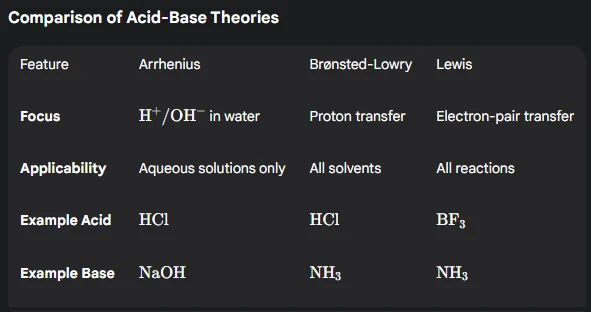
Theme: Acid-Base Theories - Lewis Acids and Bases
Explanation:
Let's analyze the reaction using the Lewis definition:
* Lewis Base: An electron pair donor.
* Lewis Acid: An electron pair acceptor.
In ammonia ($\text{N}\text{H}_{3}$), the nitrogen atom has a lone pair of electrons. Boron trifluoride ($\text{B}\text{F}_{3}$) is electron-deficient because the boron atom has an incomplete octet.
The $\text{N}\text{H}_{3}$ molecule donates its lone pair of electrons to the $\text{B}\text{F}_{3}$ molecule to form a coordinate covalent bond. Therefore, $\text{N}\text{H}_{3}$ is acting as a Lewis base.
Why other options are incorrect:
- B) As a Lewis acid: $\text{N}\text{H}_{3}$ is donating electrons, not accepting them. $\text{B}\text{F}_{3}$ is the Lewis acid.
- C) As a Brønsted-Lowry acid: This theory involves proton ($\text{H}^{+}$) donation. $\text{N}\text{H}_{3}$ is not donating a proton in this reaction.
- D) As an Arrhenius acid: This theory requires the substance to produce $\text{H}^{+}$ in water, which is not what is happening here.
- E) As both a Lewis acid and a Brønsted-Lowry base: It is acting as a Lewis base, not a Lewis acid.
Answer: → A) As a Lewis base
40
40. In the reaction $\text{Zn}() + _{4}\text{H}\text{N}\text{O}_{3}() → \text{Zn}(\text{N}\text{O}_{3})_{2}() + _{2}\text{N}\text{O}_{2}() + _{2}\text{H}_{2}\text{O}()$, which species acts as the reducing agent?
A)
$\text{Zn}()$
B)
$\text{H}\text{N}\text{O}_{3}()$
C)
$\text{N}\text{O}_{2}()$
D)
$\text{Zn}(\text{N}\text{O}_{3})_{2}()$
E)
$\text{H}_{2}\text{O}()$
Theme: Redox Reactions - Oxidizing and Reducing AgentsExplanation:
* A reducing agent is a substance that gets oxidized (loses electrons) and causes another substance to be reduced.
* An oxidizing agent is a substance that gets reduced (gains electrons) and causes another substance to be oxidized.
Let's assign oxidation states:
* $\text{Zn}()$: Oxidation state = $0$
* $\text{H}\text{N}\text{O}_{3}$: H is +1, O is -2. So, $1 + N + 3(-2) = 0 \Rightarrow N = +5$
* $\text{Zn}(\text{N}\text{O}_{3})_{2}$: $\text{N}\text{O}_{3}$ is a -1 ion. So, $Zn + 2(-1) = 0 \Rightarrow Zn = +2$
* $\text{N}\text{O}_{2}$: O is -2. So, $N + 2(-2) = 0 \Rightarrow N = +4$
Analysis:
* Zinc ($\text{Zn}$) goes from an oxidation state of $0$ to $+2$. It has lost electrons, so it is oxidized. Therefore, $\text{Zn}()$ is the reducing agent.
* Nitrogen (in $\text{H}\text{N}\text{O}_{3}$) goes from $+5$ to $+4$ (in $\text{N}\text{O}_{2}$). It has gained electrons, so it is reduced. Therefore, $\text{H}\text{N}\text{O}_{3}$ is the oxidizing agent.
Why other options are incorrect:
- B) $\text{H}\text{N}\text{O}_{3}()$: This is the oxidizing agent, as it gets reduced.
- C) $\text{N}\text{O}_{2}()$: This is a product of the reduction.
- D) $\text{Zn}(\text{N}\text{O}_{3})_{2}()$: This is a product of the oxidation.
- E) $\text{H}_{2}\text{O}()$: This is a product and its atoms do not change oxidation state.
Answer: → A) $\text{Zn}()$
41
41. Which of the following compounds has the most hydrogen atoms?
A)
2,3-Dimethylpentane
B)
Cyclohexane
C)
1,2-Dimethylcyclobutane
D)
2,3-Dimethyl-2-butene
E)
2-Hexanol
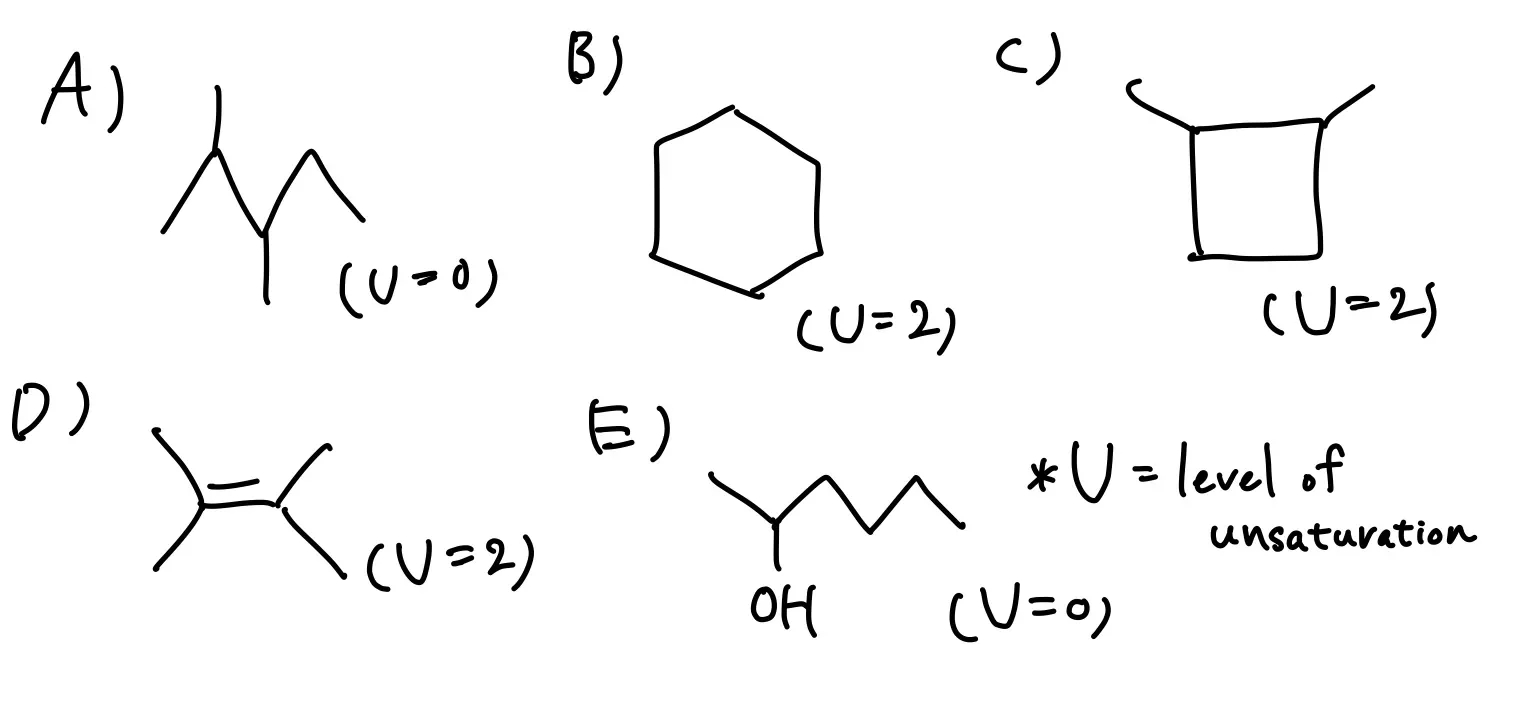
Theme: Organic Chemistry - Alkanes and Molecular Formulas
The number of hydrogen atoms in a hydrocarbon is determined by its degree of unsaturation and its carbon count. Saturated, open-chain alkanes follow the general formula $\ce{C_nH_{2n+2}}$. Every time a ring or a double bond is introduced, two hydrogen atoms are removed from this "maximum" saturated state.
- Cycloalkanes and Alkenes (with one double bond) both follow $ce{C_nH_{2n}}$.
- Cycloalkenes or compounds with two double bonds follow $ce{C_nH_{2n-2}}$.
In medical chemistry, understanding molecular weight and the "saturation" of lipids is fundamental for nutrition and metabolism studies. Saturated fats have more hydrogen per carbon than unsaturated fats, which significantly affects their melting point and physiological impact.
1. Analyze Option A: 2,3-Dimethylpentane
- Pentane backbone (5C) + 2 methyl groups (2C) = 7 carbons total ($\text{C}_{7}$).
- It is a saturated, open-chain alkane.
- Formula: $ce{C_nH_{2n+2}} = ce{C7H_{(2 imes 7)+2}} = mathbf{16 ext{ H atoms}}$.
2. Analyze Option B: Cyclohexane
- Hexane ring (6C) total.
- It is a cycloalkane (1 ring).
- Formula: $ce{C_nH_{2n}} = ce{C6H_{12}} = mathbf{12 ext{ H atoms}}$.
3. Analyze Option C: 1,2-Dimethylcyclobutane
- Cyclobutane ring (4C) + 2 methyl groups (2C) = 6 carbons total.
- It is a cycloalkane (1 ring).
- Formula: $ce{C_nH_{2n}} = ce{C6H_{12}} = mathbf{12 ext{ H atoms}}$.
4. Analyze Option D: 2,3-Dimethyl-2-butene
- Butene backbone (4C) + 2 methyl groups (2C) = 6 carbons total.
- It is an alkene (1 double bond).
- Formula: $ce{C_nH_{2n}} = ce{C6H_{12}} = mathbf{12 ext{ H atoms}}$.
5. Analyze Option E: 2-Hexanol
- Hexane backbone (6C) total.
- It is a saturated alcohol (derived from $ce{C6H_{14}}$ by replacing 1 H with 1 OH).
- Formula: $ce{C6H_{13}OH} = mathbf{14 ext{ H atoms}}$.
6. Conclusion: 2,3-Dimethylpentane has the highest count (16).
A common pitfall is forgetting the $+2$ in the alkane formula or assuming that adding functional groups like -OH increases the hydrogen count significantly. Strategy: Always count the total number of carbons first. Then, look for "H-removers": rings and double bonds. Saturated, non-cyclic molecules will always have the highest H count for a given carbon number.
Molecular formula calculations are the first step in Mass Spectrometry, a technique used in clinical pathology to identify unknown metabolites in a patient's blood. Identifying the "Hydrogen Deficit" (Degree of Unsaturation) helps researchers determine if a substance is a saturated fatty acid, a cyclic steroid, or an aromatic drug metabolite.
Answer: → A) 2,3-Dimethylpentane
42
42. Which of the following molecules does NOT contain a carbon-oxygen double bond ($\text{C} = \text{O}$)?
A)
Dimethyl ether
B)
Acetaldehyde
C)
Acetone
D)
Acetic acid
E)
Methyl acetate
Theme: Organic Chemistry - Functional Groups and the Carbonyl Group
The Carbonyl Group ($\text{C} = \text{O}$) is one of the most important functional groups in biochemistry. It consists of a carbon atom double-bonded to an oxygen atom. Due to the high electronegativity of oxygen, the carbonyl group is polar, making it a site for chemical reactivity.
- Aldehydes: Carbonyl at the end of a chain ($\text{R}-\text{C}\text{H}\text{O}$).
- Ketones: Carbonyl in the middle of a chain ($\text{R}-\text{C}\text{O}-\text{R}$).
- Carboxylic Acids: Carbonyl attached to a hydroxyl group ($\text{R}-\text{C}\text{O}\text{O}\text{H}$).
- Esters: Carbonyl attached to an alkoxy group ($\text{R}-\text{C}\text{O}\text{O}\text{R}$).
- Amides: Carbonyl attached to a nitrogen group ($\text{R}-\text{C}\text{O}\text{N}\text{H}_{2}$).
Compounds lacking this double bond, such as alcohols ($\text{R}-\text{O}\text{H}$) and ethers ($\text{R}-\text{O}-\text{R}$), have significantly different physical and chemical properties.
1. Analyze Option A: Dimethyl ether
- Structure: $\text{C}\text{H}_{3}-\text{O}-\text{C}\text{H}_{3}$.
- Class: Ether.
- Contains: Two $\text{C}-\text{O}$ single bonds. No double bond. Correct.
2. Analyze Option B: Acetaldehyde
- Structure: $\text{C}\text{H}_{3}-\text{C}\text{H}\text{O}$.
- Class: Aldehyde.
- Contains: A $\text{C} = \text{O}$ double bond.
3. Analyze Option C: Acetone
- Structure: $\text{C}\text{H}_{3}-\text{C}\text{O}-\text{C}\text{H}_{3}$.
- Class: Ketone.
- Contains: A $\text{C} = \text{O}$ double bond.
4. Analyze Option D: Acetic acid
- Structure: $\text{C}\text{H}_{3}-\text{C}\text{O}\text{O}\text{H}$.
- Class: Carboxylic acid.
- Contains: A $\text{C} = \text{O}$ double bond.
5. Analyze Option E: Methyl acetate
- Structure: $\text{C}\text{H}_{3}-\text{C}\text{O}\text{O}\text{C}\text{H}_{3}$.
- Class: Ester.
- Contains: A $\text{C} = \text{O}$ double bond.
6. Conclusion: Dimethyl ether is the only one without the $\text{C} = \text{O}$ bond.
Students often confuse "Ether" ($\text{C}-\text{O}-\text{C}$) with "Ester" ($\text{C}-\text{O}-\text{C} = \text{O}$) because the names are similar. Strategy: Memorize the suffix hierarchy. "Ether" is the simplest oxygen-bridge; "Ester" is more complex and must include the carbonyl group.
Carbonyl chemistry is central to Metabolic Biochemistry. For example, Ketone Bodies (like Acetone) are produced during fasting or in uncontrolled diabetes (Ketoacidosis). Detecting the "fruity" smell of the carbonyl-containing Acetone on a patient's breath is a classic clinical sign of a medical emergency. Understanding which molecules have these groups helps doctors predict drug reactivity and metabolism.
Answer: → A) Dimethyl ether
43
43. One atmosphere ($1 \text{ atm}$) of pressure is equivalent to all of the following EXCEPT:
A)
$1013.25 \text{ kPa}$
B)
$101325 \text{ Pa}$
C)
$1013.25 \text{ mbar}$
D)
$760 \text{ mmHg}$
E)
$760 \text{ torr}$
Theme: Physical Chemistry - Pressure Unit Conversions
Pressure is defined as force per unit area. In chemistry and medicine, various units are used depending on the context. Standard Atmospheric Pressure ($1 \text{ atm}$) was historically defined as the pressure required to support a column of mercury $760 \text{ mm}$ high.
- SI Unit: Pascal ($\text{Pa}$), where $1 \text{ Pa} = 1 \text{ N/m}^2$.
- Barometric Units: Bar and millibar ($\text{mbar}$), commonly used in meteorology.
- Manometric Units: $\text{mmHg}$ (or Torr), used in blood pressure measurement.
Understanding these conversion factors is essential for calculating gas behavior and interpreting medical diagnostic equipment.
1. Analyze Standard Definitions of $1 \text{ atm}$:
- $1 \text{ atm} = 101,325 \text{ Pa}$ (Option B is correct).
- $1 \text{ atm} = 760 \text{ mmHg}$ (Option D is correct).
- $1 \text{ atm} = 760 \text{ torr}$ (Option E is correct, as $1 \text{ torr} = 1 \text{ mmHg}$ by definition).
2. Perform Metric Conversions:
- Since $1 \text{ kPa} = 1,000 \text{ Pa}$, then $101,325 \text{ Pa} = \mathbf{101.325 \text{ kPa}}$.
- Option A claims $1013.25 \text{ kPa}$, which is ten times too large. Therefore, A is the "EXCEPT" choice.
3. Verify Option C:
- $1 ext{ bar} = 100,000 ext{ Pa}$.
- $1 ext{ mbar} = 100 ext{ Pa}$.
- $101,325 ext{ Pa} / 100 = 1013.25 ext{ mbar}$ (Option C is correct).
4. Final Result: Option A is numerically incorrect.
Common mistakes involve losing track of decimal places during metric prefix conversions (milli, kilo). Strategy: Always write out the primary SI conversion ($1 ext{ atm} approx 10^5 ext{ Pa}$) and use that as a "sanity check" to ensure your decimal point is in the right place.
Physicians must switch between these units constantly. Blood Pressure is always measured in $ ext{mmHg}$ (e.g., 120/80), but Ventilator Pressures or Intracranial Pressures are often measured in $ ext{cmH2O}$ or $ ext{kPa}$. In the Hyperbaric Chamber, pressure is measured in atmospheres ($ ext{atm}$). A doctor who cannot convert between these units risks misinterpreting clinical data.
Answer: → A) $1013.25 \text{ kPa}$
44
44. How many nitrogen atoms are contained in $0.7 \text{ g}$ of nitrogen gas ($\text{N}_{2}$)? (Atomic mass of N = $14 \text{ u}$; Avogadro's number $N_A \approx 6.02 \times 10^{23} \text{ mol}^{-1}$)
A)
$3.01 \times 10^{22}$
B)
$1.505 \times 10^{22}$
C)
$6.02 \times 10^{23}$
D)
$0.05$
E)
$0.1$
Theme: General Chemistry - Moles and Avogadro's Number
The Mole is the bridge between the microscopic world of atoms and the macroscopic world of the laboratory. One mole of any substance contains Avogadro's Number ($6.02 imes 10^{23}$) of representative particles.
- For an element (like He), the particle is the atom.
- For a molecular element (like $\text{N}_{2}$ or $\text{O}_{2}$), the particle is the molecule.
In this problem, we must perform a two-step "microscopic" analysis: first find the number of molecules of $\text{N}_{2}$, and then multiply by the number of atoms *per* molecule. This logic is essential in biochemistry to calculate the number of ligand molecules binding to a multi-subunit protein.
1. Find the Molar Mass of $\text{N}_{2}$:
- Atomic mass of $\text{N} = 14 ext{ g/mol}$.
- Nitrogen gas is diatomic ($\text{N}_{2}$), so Molar Mass = $2 imes 14 = 28 ext{ g/mol}$.
2. Calculate Moles of $\text{N}_{2}$:
- $n = ext{mass} / ext{Molar Mass}$.
- $n = 0.7 ext{ g} / 28 ext{ g/mol}$.
- $n = 7 / 280 = 1 / 40 = 0.025 ext{ moles of } \text{N}_{2}$ molecules.
3. Calculate Number of $\text{N}_{2}$ Molecules:
- $ ext{Molecules} = n imes N_A$.
- $ ext{Molecules} = 0.025 imes 6.02 imes 10^{23}$.
- $0.025$ is the same as $1/40$.
- $ ext{Molecules} = 0.1505 imes 10^{23} = 1.505 imes 10^{22}$ molecules.
4. Calculate Total Number of Nitrogen ATOMS:
- Each molecule of $\text{N}_{2}$ contains 2 atoms.
- $ ext{Atoms} = 2 imes 1.505 imes 10^{22} = mathbf{3.01 imes 10^{22} ext{ atoms}}$.
The "Trap Answer" is Option B ($1.505 imes 10^{22}$). This is the number of *molecules*. Many students forget to multiply by 2 for diatomic gases. Strategy: Always draw a quick picture of the molecule or write the formula ($\text{N}-\text{N}$) to remind yourself that one unit of the gas provides two units of the atom.
Calculations involving Avogadro's number are used in Nuclear Medicine to determine the activity of a radioactive tracer. If a doctor knows the mass of a radioactive isotope (like Iodine-131) being injected into a patient, they use this stoichiometry to calculate exactly how many atoms are undergoing decay per second, ensuring the radiation dose is within safe therapeutic limits.
Answer: → A) $3.01 \times 10^{22}$
45
45. Given the reaction $\text{C} + \text{O}_{2} → \text{C}\text{O}_{2}$, how many grams of $\text{C}\text{O}_{2}$ are produced from the complete combustion of $9 \text{ g}$ of Carbon (C)? (Atomic masses: C = $12 \text{ u}$; O = $16 \text{ u}$)
A)
$33 \text{ g}$
B)
$9 \text{ g}$
C)
$44 \text{ g}$
D)
$2.75 \text{ g}$
E)
$24 \text{ g}$
Theme: General Chemistry - Mass-Mass Stoichiometry
Chemical reactions conserve mass, but they do so through specific molar ratios. You cannot directly compare grams of one substance to grams of another. Instead, you must convert "Grams to Moles," use the "Molar Ratio" from the balanced equation, and then convert "Moles back to Grams."
In the combustion of carbon ($\text{C} + \text{O}_{2} → \text{C}\text{O}_{2}$), the ratio is $1:1$. This means every 1 mole of carbon consumed produces exactly 1 mole of carbon dioxide. However, since the molar masses of $\text{C}$ ($12 ext{ g/mol}$) and $\text{C}\text{O}_{2}$ ($44 ext{ g/mol}$) are different, the masses will not be equal.
1. Find Molar Masses:
- $M(\text{C}) = 12 ext{ g/mol}$.
- $M(\text{C}\text{O}_{2}) = 12 + (2 imes 16) = 44 ext{ g/mol}$.
2. Convert Given Mass to Moles of Carbon ($n_C$):
- $n_C = 9 ext{ g} / 12 ext{ g/mol} = 0.75 ext{ moles of C}$.
3. Apply Molar Ratio:
- From the equation, $n(\text{C}\text{O}_{2}) = n_C = 0.75 ext{ moles}$.
4. Convert Moles to Mass of $\text{C}\text{O}_{2}$:
- $ ext{Mass} = n imes M$.
- $ ext{Mass} = 0.75 ext{ mol} imes 44 ext{ g/mol}$.
- $0.75$ is the same as $3/4$.
- $ ext{Mass} = (3 imes 44) / 4 = 3 imes 11 = mathbf{33 ext{ g}}$.
The most common mistake is assuming mass is conserved 1:1 (Option B: $9 ext{ g}$). Another mistake is choosing the molar mass of $\text{C}\text{O}_{2}$ (Option C: $44 ext{ g}$) without checking the starting mass. Strategy: Always use the three-step "Bridge" method: $ ext{grams}_A → ext{moles}_A → ext{moles}_B → ext{grams}_B$.
This calculation is identical to determining Metabolic Rate via indirect calorimetry. By measuring the mass of $\text{C}\text{O}_{2}$ exhaled by a patient, a doctor can back-calculate the mass of carbon-based fuels (carbohydrates or fats) being "burned" in the body. This is crucial for nutritional assessment in critically ill patients in the ICU.
Answer: → A) $33 \text{ g}$
46
46. How many mL of water must be added to $1 \text{ mL}$ of a strong acid solution with $\text{pH} = 2$ to obtain a solution with $\text{pH} = 4$?
A)
$99 \text{ mL}$
B)
$9 \text{ mL}$
C)
$100 \text{ mL}$
D)
$10 \text{ mL}$
E)
$2 \text{ mL}$
Theme: Physical Chemistry - pH and Dilution
The pH scale is logarithmic, meaning each unit change in pH represents a 10-fold change in the concentration of hydrogen ions ($\text{H}^{+}$).
- $\text{pH} = -log_{10}[\text{H}^{+}]$.
- $[\text{H}^{+}] = 10^{-\text{pH}}$.
To change the pH from 2 to 4, the concentration of $\text{H}^{+}$ must decrease by two orders of magnitude (from $10^{-2}$ to $10^{-4}$), which is a 100-fold dilution. In a strong acid solution, we assume complete dissociation, so the dilution of the acid is directly proportional to the change in ion concentration.
1. Find Initial Concentration ($M_1$):
- $\text{pH} = 2 \Rightarrow [\text{H}^{+}] = 10^{-2} \text{ M}$.
2. Find Final Concentration ($M_2$):
- $\text{pH} = 4 \Rightarrow [\text{H}^{+}] = 10^{-4} \text{ M}$.
3. Calculate the Dilution Factor:
- $\text{Factor} = M_1 / M_2 = 10^{-2} / 10^{-4} = 10^2 = 100$.
- The solution must be diluted 100 times.
4. Determine Final Volume ($V_2$):
- $V_1 = 1 \text{ mL}$.
- $V_2 = V_1 \times \text{Factor} = 1 \text{ mL} \times 100 = 100 \text{ mL}$.
The Brønsted-Lowry theory defines an acid as a proton ($\text{H}^{+}$) donor and a base as a proton acceptor. Every acid-base reaction involves the transfer of a proton from the acid to the base, resulting in a "conjugate" pair.
- When an acid loses a proton, it becomes its Conjugate Base.
- When a base gains a proton, it becomes its Conjugate Acid.
The strength of an acid is inversely related to the strength of its conjugate base. A strong acid is one that has an extremely high tendency to donate its proton. This means the resulting conjugate base has a negligible tendency to "take it back." Therefore, strong acids always form very weak (stable) conjugate bases.
1. Analyze the Reaction: $ ext{Acid} + ext{H}_2 ext{O} leftrightarrow ext{Conjugate Base} + ext{H}_3 ext{O}^+$.
2. Define a Strong Acid: The equilibrium lies almost entirely to the right (the acid is "desperate" to lose the proton).
3. Deduce Conjugate Behavior: If the equilibrium is far to the right, it means the reverse reaction (the conjugate base taking a proton back) is highly unlikely.
4. Apply Definitions: A species that does not want to accept a proton is a weak base.
5. Match with options:
- A) Forms a weak conjugate base. (Correct).
- B) Strong conjugate base. (Incorrect; this is true for weak acids).
- C) Poor proton donor. (Incorrect; this is the definition of a weak acid).
- D) Good proton acceptor. (Incorrect; this is the definition of a base).
- E) Must be in aqueous solution. (Incorrect; this is a limitation of the Arrhenius theory, not Brønsted-Lowry).
Common confusion: "If the acid is strong, shouldn't its base also be strong?" No, acidity and basicity are like a see-saw. If one end is up (strong), the other must be down (weak). Strategy: Remember the classic example: $\text{H}\text{Cl}$ (extremely strong acid) $→ \text{Cl}^{-}$ (extremely weak base, it doesn't even affect the pH).
This relationship is the basis of Buffer Systems in the body, such as the Bicarbonate buffer. Carbonic acid is a weak acid, meaning its conjugate base (Bicarbonate, $\text{H}\text{C}\text{O}_{3}^{-}$) is relatively strong. This strength allows Bicarbonate to effectively "soak up" excess protons in the blood, maintaining a constant pH of 7.4. If we had only strong acids in our blood, we would have no ability to buffer changes in acidity.
Answer: → A) forms a weak conjugate base.
48
48. What is the simplified value of the expression $(\sqrt[3]{512})^{1/2}$?
A)
$2\sqrt{2}$
B)
$8$
C)
$4$
D)
$2^{1/6}$
E)
$512^{2/3}$
Theme: Exponents and Radicals
Explanation:
The expression can be rewritten using fractional exponents:
$(\sqrt[3]{512})^{1/2} = (512^{1/3})^{1/2}$
Using the power of a power rule ($(x^a)^b = x^{a \times b}$):
$= 512^{(1/3) \times (1/2)} = 512^{1/6}$
Now, we need to find the prime factorization of 512. We know $2^9 = 512$.
Substitute this back into the expression:
$(2^9)^{1/6} = 2^{9 \times (1/6)} = 2^{9/6} = 2^{3/2}$
To simplify $2^{3/2}$:
$2^{3/2} = 2^{1 + 1/2} = 2^1 \times 2^{1/2} = 2\sqrt{2}$
Why other options are incorrect:
- B) $8$: This is the value of $\sqrt[3]{512}$ ($8^3 = 512$), but it neglects the final $1/2$ exponent.
- C) $4$: This would be $2^2$.
- D) $2^{1/6}$: This would be correct if $512 = 2^1$.
- E) $512^{2/3}$: This inverts the exponents.
Answer: → A) $2\sqrt{2}$
49
49. Given the function $f(x)= \log_2(x^2 + 12)$, what is the reciprocal of $f(2)$?
A)
$\frac{1}{4}$
B)
$4$
C)
$\log_2(16)$
D)
$-\frac{1}{4}$
E)
$16$
Theme: Functions and Logarithms
Explanation:
1. Evaluate the function at $x=2$:
$f(2) = \log_2(2^2 + 12)$
$f(2) = \log_2(4 + 12)$
$f(2) = \log_2(16)$
2. Solve the logarithm:
We need to find the power $y$ such that $2^y = 16$.
Since $2^4 = 16$, we have $\log_2(16) = 4$.
So, $f(2) = 4$.
3. Find the reciprocal:
The reciprocal of a number $y$ is $\frac{1}{y}$.
The reciprocal of $f(2) = 4$ is $\frac{1}{4}$.
Why other options are incorrect:
- B) $4$: This is the value of $f(2)$, not its reciprocal.
- C) $\log_2(16)$: This is also the value of $f(2)$, just unevaluated.
- D) $-\frac{1}{4}$: This is the negative reciprocal.
- E) $16$: This is the argument of the logarithm, not its value.
Answer: → A) $\frac{1}{4}$
50
50. A bag contains 3 red balls and 7 green balls. What is the probability of drawing two green balls in two consecutive extractions, assuming the draws are independent (i.e., with replacement)?
A)
$\frac{49}{100}$
B)
$\frac{7}{10}$
C)
$\frac{42}{90}$
D)
$\frac{21}{100}$
E)
$\frac{9}{100}$
Theme: Probability - Independent Events
Explanation:
1. Find the total number of balls:
Total = $3 \text{ red} + 7 \text{ green} = 10 \text{ balls}$
2. Find the probability of drawing one green ball:
$P(\text{Green}) = \frac{\text{Number of green balls}}{\text{Total number of balls}} = \frac{7}{10}$
3. Calculate the probability of two independent events:
The problem implies independent draws (or drawing with replacement). The probability of two independent events (A and B) occurring is $P(A \text{ and } B) = P(A) \times P(B)$.
$P(\text{Green then Green}) = P(\text{Green on 1st}) \times P(\text{Green on 2nd})$
$P(GG) = \left(\frac{7}{10}\right) \times \left(\frac{7}{10}\right) = \frac{49}{100}$
Why other options are incorrect:
- B) $\frac{7}{10}$: This is the probability of drawing only one green ball.
- C) $\frac{42}{90}$: This would be the probability *without* replacement ($\frac{7}{10} \times \frac{6}{9}$).
- D) $\frac{21}{100}$: This might result from $\frac{3}{10} \times \frac{7}{10}$ (probability of Red then Green).
- E) $\frac{9}{100}$: This would be the probability of drawing two red balls ($\frac{3}{10} \times \frac{3}{10}$).
Answer: → A) $\frac{49}{100}$
51
51. What is the solution to the inequality $\frac{x^2 + |4x + 3|}{4 - 3x} \geq 0$?
A)
$x < \frac{4}{3}$
B)
$x > \frac{4}{3}$
C)
$x \geq -\frac{3}{4}$
D)
$x = 0$
E)
All real numbers
Theme: Solving Inequalities
Explanation:
We need to solve $\frac{N(x)}{D(x)} \geq 0$, where $N(x) = x^2 + |4x + 3|$ and $D(x) = 4 - 3x$.
1. Analyze the Numerator, $N(x)$:
* $x^2$ is always non-negative ($x^2 \geq 0$).
* $|4x + 3|$ (an absolute value) is also always non-negative ($|4x + 3| \geq 0$).
* The sum of two non-negative terms $N(x) = x^2 + |4x + 3|$ is also non-negative ($N(x) \geq 0$).
* Can $N(x) = 0$? This would require $x^2 = 0$ (so $x=0$) AND $|4x + 3| = 0$ (so $x=-3/4$). Since $x$ cannot be both $0$ and $-3/4$ simultaneously, the numerator is *never* zero. It is always strictly positive ($N(x) > 0$).
2. Analyze the Inequality:
Since the numerator is always positive, for the fraction $\frac{\text{Positive}}{D(x)} \geq 0$, the denominator $D(x)$ must also be positive.
* Note: $D(x)$ cannot be zero, as division by zero is undefined. So we must have $D(x) > 0$.
3. Solve for $D(x) > 0$:
$4 - 3x > 0$
$4 > 3x$
$\frac{4}{3} > x$, which is the same as $x < \frac{4}{3}$.
Why other options are incorrect:
- B) $x > \frac{4}{3}$: This would make the denominator negative, and the whole fraction negative.
- C) $x \geq -\frac{3}{4}$: This range includes values (like $x=2$) that make the denominator negative.
- D) $x = 0$: This is one solution, but not the complete solution set.
- E) All real numbers: This is incorrect, as any $x \geq \frac{4}{3}$ is not a solution.
Answer: → A) $x < \frac{4}{3}$
52
52. In a circle, $\theta$ is the acute angle formed between the tangent at point A and the chord AB. $\phi$ is the angle $\angle BDA$, where D is a point on the major arc AB. What is the relationship between $\phi$ and $\theta$?
A)
$\phi = \theta$
B)
$\phi = 2\theta$
C)
$\theta = 2\phi$
D)
$\phi + \theta = 90^\circ$
E)
$\phi + \theta = 180^\circ$
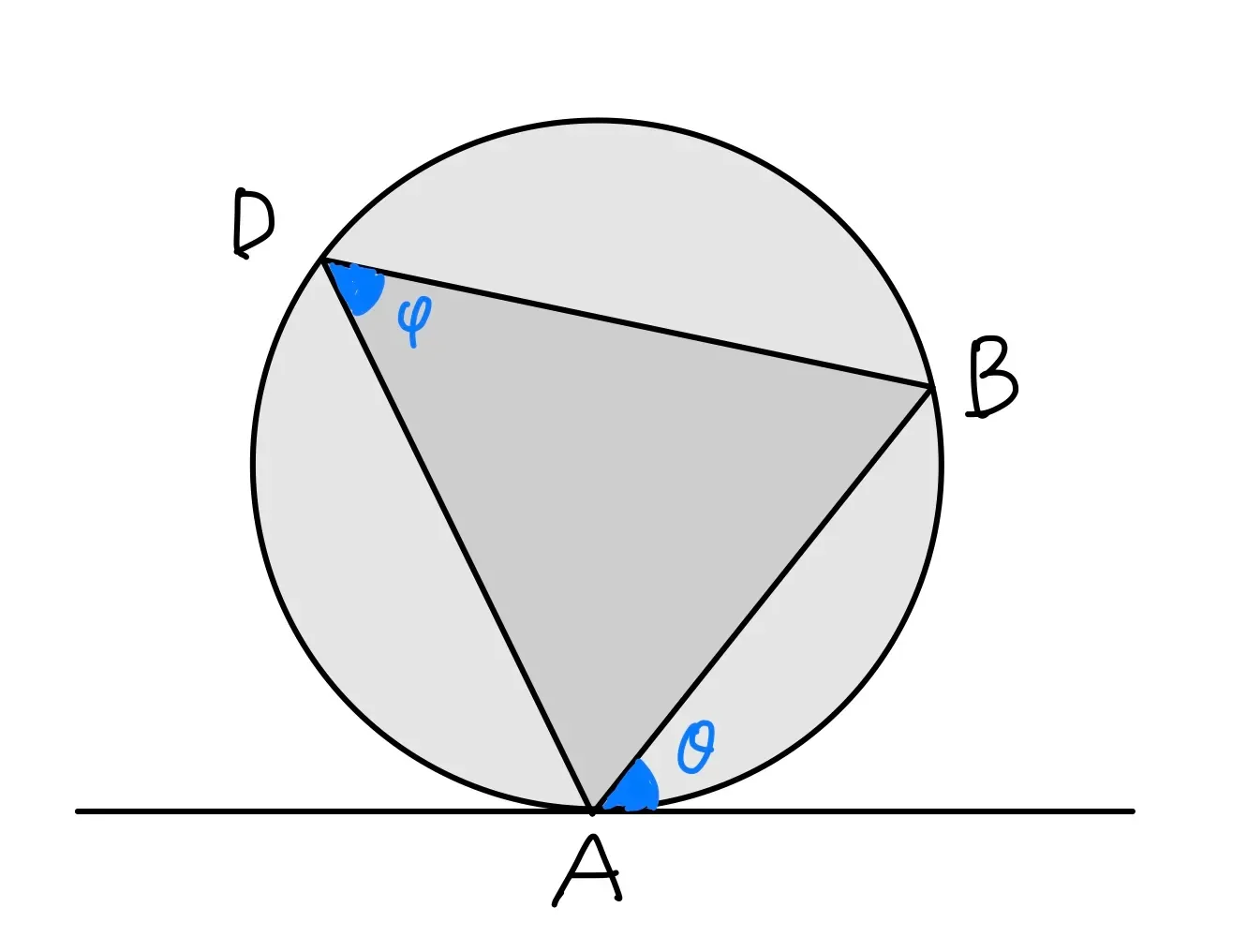
Theme: Circle Geometry - Alternate Segment Theorem
Explanation:
This question describes the Alternate Segment Theorem.
* $\theta$ is the angle between the tangent (at A) and the chord (AB).
* $\phi = \angle BDA$ is the inscribed angle subtended by the chord AB in the *alternate segment* (the major arc).
The Alternate Segment Theorem states that the angle between a tangent and a chord through the point of contact is equal to the angle in the alternate segment.
Therefore, $\phi = \theta$.
Why other options are incorrect:
- B) $\phi = 2\theta$ & C) $\theta = 2\phi$: The 2:1 relationship is between the central angle and the inscribed angle, which are not described here.
- D) $\phi + \theta = 90^\circ$: This would only be true in a special case, such as if the chord AB formed a $45^\circ$ angle with the tangent.
- E) $\phi + \theta = 180^\circ$: This describes the relationship for opposite angles in a cyclic quadrilateral, which doesn't apply here.
Answer: → A) $\phi = \theta$
53
53. What is the volume of a cylinder with a base radius $r$ and height $h$, if $r^2 = 25 \text{ cm}^2$ and $h = 7 \text{ cm}$?
A)
$175\pi \text{ cm}^3$
B)
$35\pi \text{ cm}^3$
C)
$125\pi \text{ cm}^3$
D)
$25\pi \text{ cm}^3$
E)
$175 \text{ cm}^3$
Theme: Geometry - Volume of a Cylinder
Explanation:
The formula for the volume $V$ of a cylinder is:
$V = (\text{Area of Base}) \times \text{Height}$
The base is a circle, so its area is $A = \pi r^2$.
$V = \pi r^2 h$
We are given the values for $r^2$ and $h$ directly:
* $r^2 = 25 \text{ cm}^2$
* $h = 7 \text{ cm}$
Substitute these values into the formula:
$V = \pi (25 \text{ cm}^2) (7 \text{ cm}) = 175\pi \text{ cm}^3$
Why other options are incorrect:
- B) $35\pi \text{ cm}^3$: This might result from $5 \times 7 \times \pi$ (using $r=5$ instead of $r^2$).
- C) $125\pi \text{ cm}^3$: This might result from $25 \times 5 \times \pi$ (using $r^2 \times r$).
- D) $25\pi \text{ cm}^3$: This is the area of the base, not the volume.
- E) $175 \text{ cm}^3$: This omits the $\pi$ from the formula.
Answer: → A) $175\pi \text{ cm}^3$
54
54. In a right triangle, $a$ and $b$ are the lengths of the two legs (cathetus), and $c$ is the length of the hypotenuse. If $\alpha$ is the angle opposite leg $a$, which expression is correct?
A)
$a = c \sin(\alpha)$
B)
$a = c \cos(\alpha)$
C)
$a = b \sin(\alpha)$
D)
$c = a \sin(\alpha)$
E)
$a = c \tan(\alpha)$
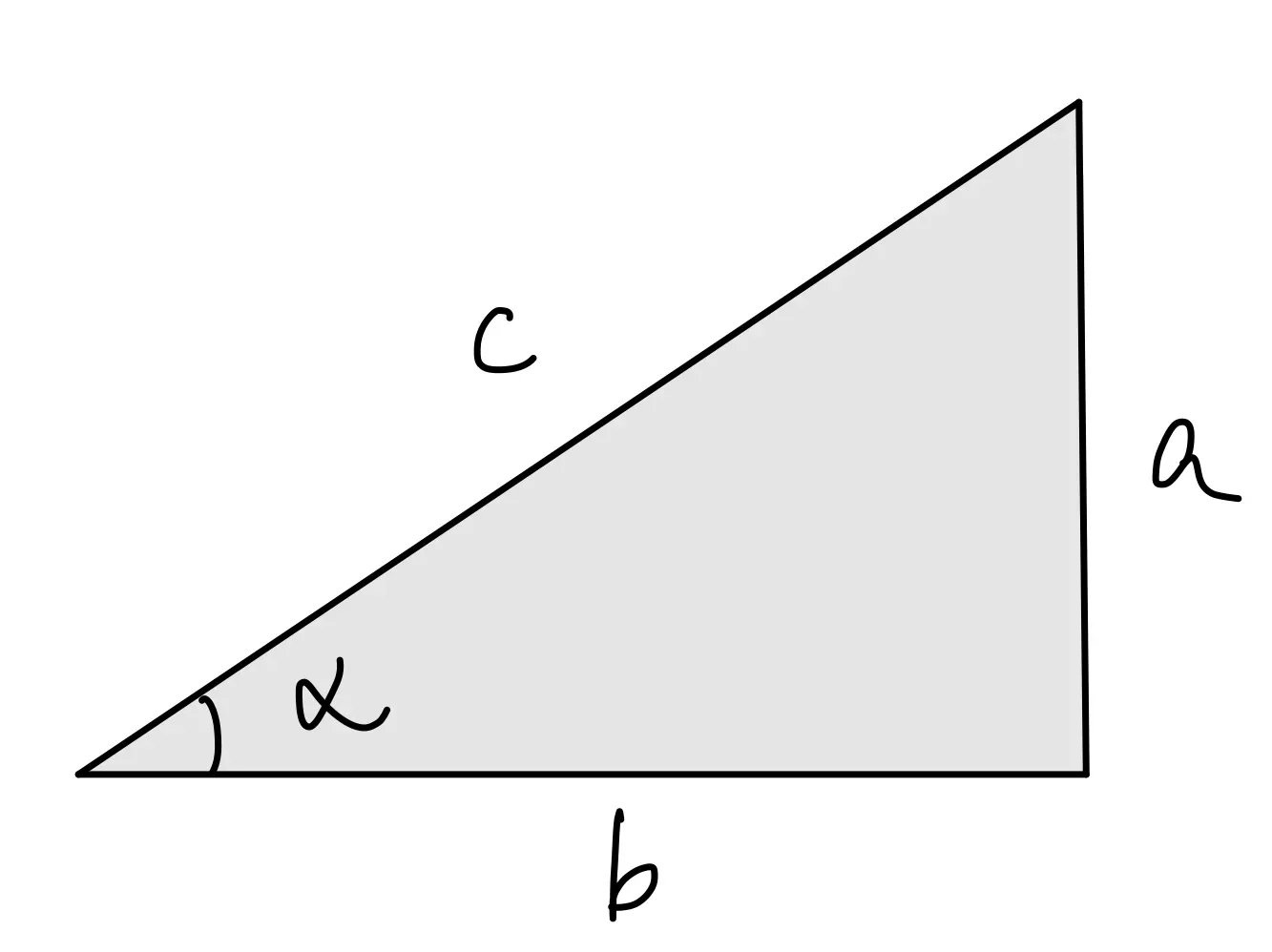
Theme: Trigonometry - SOH CAH TOA
Explanation:
The basic trigonometric definitions in a right triangle are (SOH CAH TOA):
* $\sin(\text{angle}) = \frac{\text{Opposite}}{\text{Hypotenuse}}$
* $\cos(\text{angle}) = \frac{\text{Adjacent}}{\text{Hypotenuse}}$
* $\tan(\text{angle}) = \frac{\text{Opposite}}{\text{Adjacent}}$
In this problem:
* The angle is $\alpha$.
* The Opposite side is $a$.
* The Hypotenuse is $c$.
Using the sine definition (SOH):
$\sin(\alpha) = \frac{a}{c}$
To solve for $a$, we multiply both sides by $c$:
$a = c \sin(\alpha)$
Why other options are incorrect:
- B) $a = c \cos(\alpha)$: $\cos(\alpha)$ relates the adjacent side ($b$) and hypotenuse ($c$), so $b = c \cos(\alpha)$.
- C) $a = b \sin(\alpha)$: This incorrectly mixes the sine ratio.
- D) $c = a \sin(\alpha)$: This is an incorrect rearrangement of the formula.
- E) $a = c \tan(\alpha)$: $\tan(\alpha)$ relates the opposite ($a$) and adjacent ($b$), so $a = b \tan(\alpha)$.
Answer: → A) $a = c \sin(\alpha)$
55
55. A constant braking force $F = 210 \text{ N}$ is applied to an object over a distance $s = 5 \text{ m}$. Which of the following is required to calculate the power $P$ exerted by this force?
A)
The time $t$ over which the force was applied, or the speed $v$ of the object.
B)
The mass $m$ of the object.
C)
The initial speed $v_0$ of the object only.
D)
The final speed $v_f$ of the object only.
E)
No additional information is needed.
Theme: Work, Energy, and Power
Explanation:
This question was deemed flawed in the original test because it asked for a numerical answer that was impossible to calculate. The core issue is the definition of power.
Power ($P$) is the rate at which work ($W$) is done.
$P = \frac{W}{t}$
Work done by a constant force is $W = Fs$.
So, $P = \frac{Fs}{t}$.
We are given $F$ ($210 \text{ N}$) and $s$ ($5 \text{ m}$), but we do not know the time $t$.
Alternatively, if the force is applied to an object moving at speed $v$, the power is $P = Fv$. We do not know $v$.
Therefore, to calculate the power, we need either the time $t$ or the speed $v$. (If $v$ is not constant, $P = Fv$ gives instantaneous power, while $P = W/t$ gives average power).
Why other options are incorrect:
- B) The mass $m$ of the object: Mass would be needed to find acceleration ($a = F/m$), but not power directly.
- C) & D) Initial or final speed only: Knowing just one speed isn't enough to find $t$ or the average speed without knowing the acceleration (which requires mass).
- E) No additional information is needed: This is incorrect, as $t$ or $v$ is missing.
Answer: → A) The time $t$ over which the force was applied, or the speed $v$ of the object.
56
56. An ideal gas is at an initial state with pressure $P$ and volume $V$. If the volume is tripled to $3V$ while the temperature remains constant, what is the new pressure $P'$?
A)
$\frac{P}{3}$
B)
$3P$
C)
$P$
D)
$\frac{P}{9}$
E)
$9P$
Theme: Gas Laws - Boyle's Law
Explanation:
This scenario describes an isothermal (constant temperature) process for an ideal gas.
Boyle's Law states that for a fixed amount of gas at constant temperature, pressure and volume are inversely proportional.
$P_1 V_1 = P_2 V_2$
Given:
* $P_1 = P$
* $V_1 = V$
* $V_2 = 3V$
* $P_2 = P'$
Substitute the values:
$P \times V = P' \times (3V)$
Divide both sides by $3V$ to solve for $P'$:
$P' = \frac{PV}{3V} = \frac{P}{3}$
Tripling the volume at constant temperature reduces the pressure to one-third of its original value.
Why other options are incorrect:
- B) $3P$: This would happen if the volume was reduced to $V/3$.
- C) $P$: The pressure only stays constant if the volume also stays constant (at constant T).
- D) & E): The 9:1 ratio relates to squared terms, which are not relevant here.
Answer: → A) $\frac{P}{3}$
57
57. A conductor dissipates $P = 2922 \text{ W}$ of power when a current $I = 10 \text{ A}$ flows through it. What is the resistance $R$ of the conductor?
A)
$29.22 \Omega$
B)
$292.2 \Omega$
C)
$2.922 \Omega$
D)
$29220 \Omega$
E)
$0.0034 \Omega$
Theme: Electric Circuits - Joule's Law (Power)
Explanation:
The relationship between power ($P$), current ($I$), and resistance ($R$) is given by Joule's Law of heating:
$P = I^2 R$
We are given $P$ and $I$ and need to find $R$.
Given:
* $P = 2922 \text{ W}$
* $I = 10 \text{ A}$
Rearrange the formula to solve for $R$:
$R = \frac{P}{I^2}$
Substitute the values:
$R = \frac{2922 \text{ W}}{(10 \text{ A})^2} = \frac{2922 \text{ W}}{100 \text{ A}^2}$
$R = 29.22 \Omega$
Why other options are incorrect:
- B) $292.2 \Omega$: This would be the result of $P / I$, which is Voltage ($V$), not Resistance.
- C) $2.922 \Omega$: This is off by a factor of 10.
- D) $29220 \Omega$: This is the result of $P \times I$, which is not a standard formula.
- E) $0.0034 \Omega$: This is the result of $I^2 / P$, the inverse of the correct calculation.
Answer: → A) $29.22 \Omega$
58
58. An electron enters a uniform magnetic field $\vec{B}$ at a velocity $\vec{v}$ that is perpendicular to $\vec{B}$. Which of the following statements about the electron's motion is FALSE?
A)
The electron moves with a constant velocity $\vec{v}$.
B)
The radius of its path is $r = \frac{m_e v}{e B}$.
C)
The period of its motion is $T = \frac{2 \pi m_e}{e B}$.
D)
The angular velocity of its motion is $\omega = \frac{e B}{m_e}$.
E)
The magnetic force provides the centripetal acceleration.
Theme: Electromagnetism - Charged Particle in a Magnetic Field
Explanation:
1. Force: The magnetic (Lorentz) force $\vec{F} = q(\vec{v} \times \vec{B})$ is always perpendicular to the velocity $\vec{v}$.
2. Work and Speed: Since the force is always perpendicular to the direction of motion, it does no work ($W = 0$). By the work-energy theorem, the kinetic energy ($KE = \frac{1}{2}m_e v^2$) and thus the speed $v$ (magnitude of velocity) remain constant.
3. Velocity: Because the force is perpendicular, it continuously changes the *direction* of the velocity vector. Since the direction changes, the velocity vector $\vec{v}$ is NOT constant. A constant velocity requires both constant speed and constant direction.
4. Motion: This constant-magnitude perpendicular force acts as a centripetal force ($F_c = \frac{m_e v^2}{r}$), causing the electron to move in a uniform circular path.
* $F_B = F_c \Rightarrow e v B = \frac{m_e v^2}{r} \Rightarrow r = \frac{m_e v}{e B}$. (Statement B is true).
* $\omega = \frac{v}{r} = \frac{v}{(\frac{m_e v}{e B})} = \frac{e B}{m_e}$. (Statement D is true).
* $T = \frac{2\pi}{\omega} = \frac{2 \pi m_e}{e B}$. (Statement C is true).
* The magnetic force *is* the net force providing the centripetal acceleration. (Statement E is true).
Therefore, statement A is false.
Answer: → A) The electron moves with a constant velocity $\vec{v}$.
59
59. The position of a particle in oscillatory motion is given by $x(t) = 4 \cos(\omega t)$, with angular frequency $\omega = 2\pi \text{ rad/s}$. What is the velocity of the particle at $t = \frac{1}{2} \text{ s}$?
A)
$0 \text{ m/s}$
B)
$-8\pi \text{ m/s}$
C)
$4 \text{ m/s}$
D)
$-4 \text{ m/s}$
E)
$8\pi \text{ m/s}$
Theme: Simple Harmonic Motion (SHM)
Explanation:
1. Find the velocity function $v(t)$:
Velocity is the first derivative of position $x(t)$ with respect to time $t$.
$v(t) = \frac{dx}{dt} = \frac{d}{dt} [4 \cos(\omega t)]$
Using the chain rule: $v(t) = 4 \times [-\sin(\omega t) \times \omega] = -4\omega \sin(\omega t)$
2. Substitute the value of $\omega = 2\pi$:
$v(t) = -4(2\pi) \sin(2\pi t) = -8\pi \sin(2\pi t)$
3. Calculate velocity at $t = \frac{1}{2} \text{ s}$:
$v(\frac{1}{2}) = -8\pi \sin(2\pi \times \frac{1}{2}) = -8\pi \sin(\pi)$
4. Evaluate $\sin(\pi)$:
The sine of $\pi$ radians ($180^\circ$) is $0$.
$v(\frac{1}{2}) = -8\pi \times (0) = 0 \text{ m/s}$
(This makes physical sense: at $t=T/2 = 1/2 \text{ s}$, the particle has completed half an oscillation and is momentarily at rest at the other extreme position $x=-4$).
Why other options are incorrect:
- B) $-8\pi \text{ m/s}$: This is the maximum speed, which occurs when $\sin(2\pi t) = 1$ (e.g., at $t=1/4 \text{ s}$).
- C) $4 \text{ m/s}$: This is the amplitude of position.
- D) $-4 \text{ m/s}$: This is the position $x(t)$ at $t=1/2 \text{ s}$, not the velocity.
- E) $8\pi \text{ m/s}$: This is the magnitude of the maximum speed.
Answer: → A) $0 \text{ m/s}$
60
60. Which of the following statements about the motion of a simple pendulum is FALSE?
A)
Without friction, a pendulum stops after a few oscillations.
B)
Without friction (and for small angles), the motion is simple harmonic oscillation.
C)
With friction, the motion is a damped oscillatory motion.
D)
The pendulum stops momentarily at the highest point of its swing.
E)
The pendulum bob moves along a circular arc.
Theme: Simple Harmonic Motion - Pendulum
Explanation:
Let's analyze the physics of a simple pendulum.
* B) Simple Harmonic Motion: For small angles of displacement, the restoring force is approximately proportional to the displacement ($F \approx -mg\theta$). This condition leads to Simple Harmonic Motion (SHM). This statement is true.
* C) Damped Motion: In a real-world scenario, friction (air resistance) is a dissipative force that removes energy from the system, causing the amplitude of the oscillations to decrease over time. This is called damped oscillation. This statement is true.
* D) Highest Point: At the peak (maximum amplitude) of its swing, the pendulum's kinetic energy is zero, and its potential energy is maximum. It is momentarily at rest before reversing direction. This statement is true.
* E) Circular Arc: The pendulum bob is fixed by a string of constant length $L$, so it swings along the arc of a circle with radius $L$. This statement is true.
* A) No Friction: In an ideal, frictionless system (in a vacuum), mechanical energy is conserved. The pendulum would never lose energy and would continue to oscillate indefinitely. Therefore, the statement that it *stops* is false.
Answer: → A) Without friction, a pendulum stops after a few oscillations.
Section Review
Biology
A total of 23 questions primarily focused on cell biology, genetics, and molecular topics.
Questions were straightforward, requiring knowledge of fundamental concepts.
Simplified compared to prior years, with no anatomy or physiology questions, making Biology the easiest section this year.
Chemistry
Consisted of 15 questions, with topics like the mole concept, properties of gases, and acids and bases being heavily emphasized.
Difficulty was moderate but decisive for student rankings due to its balanced design.
A strong performance in Chemistry was crucial for distinguishing oneself.
Physics
Included 6 questions covering kinematics, thermodynamics, and electromagnetism.
Key topics involved electron motion in magnetic fields and simple harmonic motion.
While varied, it was approachable for those with a solid understanding of fundamental formulas and applications.
Mathematics
Featured 7 questions focusing on algebra, geometry, and probability.
Geometry and algebra were core scoring areas, with moderate difficulty levels.
Understanding key formulas and properties (e.g., logarithms and circles) was vital for success.